Sunday, July 11, 2010

Latest Issue of ABK – Barbara Heidenrich steps up for Pet Parrot Pointers

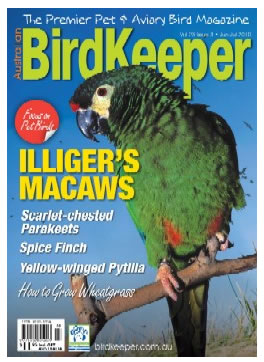
If you haven’t picked up the latest issue of Australian Birdkeeper Magazine from your newsagent then you should grab it while it’s there! Barbara Heidenreich has filled in for the Pet Parrot Pointers section of the magazine with an absolute cracker of an article on `Ten Common Training Mistakes’. It’s just such a beautifully put together summary of the things well all tend to do at times and what we need to be mindful of to ensure our training failures don’t become mistakes that break down the relationships we have built with our birds.

I’m hoping that every second or third issue of ABK will feature a guest Pet Parrot Pointers writer so that we can learn from a variety of passionate parrot keepers and trainers. I’m looking forward to this opportunity for sharing and learning with Australia parrot enthusiasts.

Parrots 2010 Convention – The Culmination of a 10-Year Vision

Sometime in 1999 I sat in an office with a group of Parrot Society of Australia committee members and together we put together a plan for the very first `Parrots’ convention. That event was held in 2000 and featured 1 international speaker (Rick Jordan) and a single day program of breeder focused lectures. It was a terrific success and reinforced for those of us who were involved that this was an educational opportunity that we simply had to deliver to parrot enthusiasts in Australia. In 2002 we increased our scope with 2 international speakers (William Horsfield and Lyrae Perry) but stayed conservative with our single day program scheduling. 2004 saw a big leap of faith with a 1.5 day program and it was the first time that we integrated some `breakout’ workshops with a focus on parrot behaviour and raising pet birds. The key speaker for that event was EB Cravens and since then he has maintained a profile here in Australia via his Hookbill Hobbyist column in Australian Birdkeeper Magazine. In 2006 the window of opportunity was finally opened for me to get some serious parrot behaviour and training content added to the program and I was able to bring Barbara Heidenreich to Australia for the first time. The two-day program was a success and the program scope and sequence was a first for an avicultural convention in Australia. Barabara’s lectures were so enthusiastically received that we invited her back for the Parrots 2008 Convention and expanded on the behaviour, training and enrichment scope of the event whilst maintaining international standard breeding lectures. The 2008 Convention also saw the integration of dedicated lectures on the conservation biology of parrots in the wild with Dr. Don Brightsmith presenting both during the day program and also as keynote speaker at the Conservation Dinner.

That brings us to 2010 and an event that truly was the culmination of a vision I had back in 1999 for what I wanted to see delivered to Australian parrot enthusiasts. A full two day program with the best and most progressive information on breeding, conservation biology, behaviour, training and enrichment all delivered by some of the most experienced presenters in their respective fields. From Steve Martin to Dr. Susan Friedman, Dr. Rob Heinsohn to Dr. Jamie Gilardi, Roger Sweeney to Dr. Susan Clubb, Nic Bishop to Dr. David Waugh - absolutely the finest lineup you'll find anywhere. If you missed it then tough – sorry, only way I can put it. These opportunities for learning are rare folks – really rare. When they come up – grab them, embrace them, engage in them. You owe it to the parrots you keep. For those of you who were there – thankyou, thankyou sincerely for making such an investment in your own knowledge and in ensuring that you are providing the best standards of care and behaviour management for your birds.


The Parrots 2010 Guest Speaker Lineup - A diversity of lecture presentations and scope for a two day program that was the best of its kind for an avicultural convention - anywhere in the world

Enrichment Aviary Project – Final Update

Well – I made it. Just. For those of you (there might be one out there – hmmm?) who have followed the enrichment aviary project updates, the goal was to have this completed before the Parrots 2010 Convention. As it turned out, I managed to pull it off with the last of the fittings completed and the birds relocated just 5 days before I left for the Convention.

The lecture on enrichment aviary design and construction at Parrots 2010 was really well received and I was stoked with the positive feedback from the delegates. I have just submitted the first part of a two-part article on the process that will feature in the next two issues of Australian Birdkeeper Magazine. Look for the first instalment in the Aug/Sep issue – out mid August. Now onto new projects!


The Enrichment Aviary Complex - Home to my Amazon Parrots.

Sunday, June 13, 2010

Enrichment Aviary Project – Update 3

Things are getting very tight time wise with just over three weeks to go to the Parrots 2010 and the focus of one of my presentations – designing and constructing an outdoor enrichment aviary, yet to be completed! This is seriously going to come down to the wire and I’m getting nervous. Here are some pics and a few updates to let you know where we are up to. A long way still to go before these are inhabitable…

Aviary Footings
Traditional footings for aviaries are usually designed to provide a concrete platform around the full perimeter of the enclosure. This provides both a uniformly flat base and a solid anchor point. Normally, a trench will be dug around the perimeter to facilitate the construction of a concrete footing 200mm in depth and 150mm wide for a small complex. I have done this in the past with some of my aviaries and it’s both labour intensive and costly. For the enrichment aviary complex I decided to do things a little differently and just anchor the primary corners of the complex to a concrete base, rather than run the concrete around the full perimeter. We welded base plates to each corner of the frame and drilled a hole to facilitate dropping a 10 gauge bolt into the base plate. The bolt was positioned upside down with an oversized washer at the bolt head and a washer and nut at the screw head. The concrete was then poured into a pre-dug hole at each corner, encasing the length of the bolt below the base plate. Once the concrete was dried, the bolt was tightened to further secure the frame to the ground. I’ll discuss why we can get away with this level of footing security in my presentation at Parrots 2010.


Landscaping and Planting
The past two days have been huge with plenty of digging and planting going on in and around the aviaries. I’m not finished yet but here’s a snapshot of some of the landscaping work in progress.


Time
I gotta say, when this is all done – the one thing I am looking forward to more than anything else is being able to spend more time with two of my favourite animals – my daughter Darcy and my Rotty Rosie!


Small Parrots – Love ‘em!


I recently had the opportunity to work with a Meyer’s Parrot (Poicephalus meyeri) that belongs to a friend of mine. I needed an extra bird for a hands-on parrot-training workshop I was teaching at the Pan-Pacific Veterinary Conference and the little Meyer’s ended up being perfect (that's her in the pic above). We had her at our place for the week leading up to the Conference and it was the first time in over a year that we’ve had a parrot indoors `living’ with us. It got me thinking about just how much more appropriate the small parrot species are as indoor companion animals as opposed to the medium and large parrots that increasingly seem to be grabbing the attention of companion parrot buyers in Australia.

What is a real shame is that species such as the Meyer’s, and indeed the whole Poicephalus group, are so rare in Australia that their value places them well and truly out or the reach of the pet bird owner. We have a unique situation here in Australia in regards to the availability of parrots. Our native species are plentiful, affordable, and as such, are commonly kept as pets. Many of the small non-native or `exotic’ parrots are rare, exceedingly expensive, and therefore not an option for the pet bird owner.

Unfortunately, many of the Australian native species, in my opinion, are much less suited to captive conditions, particularly the situations generally encountered in indoor pet environments. There are some good exceptions – the humble Budgerigar is as good as any, but it would be interesting to do a study on the behaviour spectrum and capacity of different species to maintain functional behaviours when kept as pets. I bet we would see some enlightening results that would shift people’s attentions more towards the little guys. Easier to cater for in terms of enclosure size, less mess, less destructive, quieter, flights aren’t much of an issue, and they’re just a heck of a lot easier to keep amused!

Monday, May 31, 2010

Good Bird Magazine - New Format!


You have to hand it to Barbara Heidenreich. She just continues to come up with great initiatives and products for the companion parrot owner that just nail it in terms of quality of content and accessibility. Barbara has now taken her `Good Bird' magazine to the next level and future editions of the magazine will offer a fully electronic, multimedia experience for subscribers. You can check out a preview version of the new magazine at the link via her website. I've e-mailed Barbara to see if the new format will work on iPads - hopefully it will as I've been looking for an excuse to get one ;-) Check out the new stuff from Barbara and Good Bird Magazine at http://members.goodbirdinc.com/hp_joomla_15/

Sunday, May 30, 2010

Enrichment Aviary Project - Update 2

Big day at work here at El Rancho Jimbo with some good progress made on the Enrichment Aviary Project. This project is in preparation for a presentation that I will be delivering at the Parrots 2010 Convention in Brisbane on July 3-4. That means there's only 5 weeks left for me to get these darn enclosures finished - Agghh!!!

The positive news is that the painting is complete and today we were able to bolt together the three enclosure frames to the central walkway frame. The next set of `build' stages will involve securing the corner footings, putting on the roof sheeting, and hanging the doors. I'm confident that I can pull that off in a weekend and then it's on to the `good' stuff - landscaping, perching and fit out. With just 5 weeks to go I'm going to post about the progress weekly so you guys will see if I get it done in time! Otherwise... It'll be a short lecture at Parrots 2010 :-) Check out some updated images below.


Front two enclosures - each will be home to our Amazon Parrots. We have used solid colorbond 1.6mm sheets as wall partitions for the back wall and a 1/3 screen along the walkway.

A view looking into the walkway. The walkway is actually a separate frame that the three enclosures are bolted onto. It's part of a design method I came up with when we built the original three enclosures and gives a bit more flexibility down the track if we decide to change the layout of the complexes.


A view from the pathway leading to the complex. Landscaping will be completed around the outside of aviaries to provide natural screening for the birds.