Showing posts with label parrot training. Show all posts

Monday, September 20, 2010

Maya’s Training Diary – Accepting `Touch’

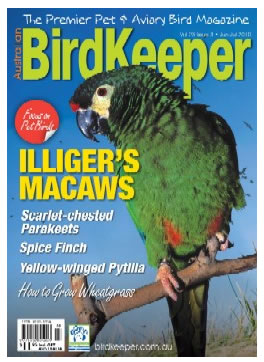
I’ve had an incredibly `full’ time over the past few months and one aspect of my lifestyle that tends to take an unfortunate back seat during busy times is focused training with some of my own birds. Kinda happens when you have a pretty demanding 22-month-old daughter and 3-week-old twins to take priority over `other’ stuff. Over the past couple of weeks (in between hospital visits to see `me boys'), I had a few windows of opportunity to work with my Green-winged Macaw `Maya’. Check out some older posts for the background with this bird. Thanks mostly to the inconsistency of my training time with her we hit a speed bump in getting some behavioural momentum in regards to stepping on to hands consistently without aggression. There were obvious behavioural indicators from her that suggested that I was more than likely setting myself and her up to fail if I stuck with the criteria schedule I had set. Sometimes when you are working with a really challenging bird and have reached stagnation in behavioural momentum towards a specific training goal it can help to change focus and work on something completely different that has a lower set of expectations and greater opportunity for success in order to build back the trust and momentum you were previously working towards. This is beneficial not just for the bird, but also for the trainer or owner to avoid the frustration that can settle in when you feel like you’re not getting where you want to go. The interesting dynamic with training animals is that it’s not just about reinforcement for the animal – the trainer needs it continually too to keep their own confidence and behavioural momentum progressing positively and maintaining that sense that they're succeeding as well. One goal I was keen to achieve was for Maya to be less sensitive to hands and hopefully even accept some tactile touch in the form of a head scratch. She had never allowed this – at any time in her life thus far, and certainly any attempt to put a hand near her head would absolutely result in an aggressive `jab’ to deter it from intruding into her personal space. It still does actually, but with some careful and patient training I can actually get some really cool tactile head touch without aggression. A big milestone for us and something that will hopefully pay off as another reinforcement option and a growing level of trust between her and my hands. The following sequence of images gives some insight into where we're at with Maya. I won’t go into elaborations as I’d like to do some writing on working with her for my ABK column next year. Good magazine that – go buy a copy! www.birdkeeper.com.au


Training the Trainers at Alma Park Zoo

I have been doing some consultative work with the team at Alma Park Zoo in Brisbane. They have recently acquired some birds that they are keen to display and develop some interactivity with. It’s been really refreshing working with a Zoo team that is super responsive and open to learning from an outside consultant – something that’s not always a hallmark of Zoo operations. For me it reinforces a really important element to `learning’ – it doesn’t occur within a vacuum. Sometimes you just have to open up and allow new ideas and outside expertise and experience to filter in and challenge your existing approaches, establish new levels of understanding or guide you in developing new ways of thinking. One key aspect of working with this particular goal set was developing `structure’ in the approach to implementing the management and training of the birds. If I could summarise using an acronym around that word `S-T-R-U-C-T-U-R-E’ what I was really keen to see the keepers working with those birds achieve it would be as follows…

Set the keepers and the birds up for success through understanding the nature of the animal and the laws of behaviour before establishing your expectations.

Teamwork generates collegiality amongst staff and creates supportive dialogue between keepers that improves training and husbandry results.

Respect for the body language and observable state of the animal you are working is vital in informing decision-making and setting training expectations.

Using positive reinforcement as your foundation for building a trust account with your animals and creating desirable lifelong learning experiences establishes the foundation for lifelong relationships

Criteria for success for both the animals and keepers need to be achievable, and are best located along a continuum that generates behavioural momentum through timely delivery of positive reinforcement.

Training is simply learning – it happens every time we engage with the animals in our care and with the peer staff we are working with.

Understanding the natural anatomy and biology of the animal you are working and setting the environment up to make shifting an animal from A to B as natural a physical movement for that animal as possible. 

Reflecting on training and being prepared to recognise areas for improvement not as criticisms but as opportunities to reach your goals.

Ending on a good note – always seeking to keep those training criteria achievable and knowing when to stop a session to set your next encounter up on a winner.

If you haven’t stopped in to Alma Park Zoo lately then it’s worth a visit. Best option is to take a picnic lunch and take advantage of the free barbecues onsite and great outdoor garden eating areas. Snags and Spider Monkeys – Who could ask for more? More info at www.almaparkzoo.com.au

I snapped a shot of this peacock displaying next to my car on my way out after my last consult at Alma Park Zoo - magnificent birds!!!

Saturday, September 4, 2010

New DVD From Good Bird Inc

Barbara Heidenreich has just released a new addition to her standard setting DVD series - `The Basics of Parrot Training: A Live Workshop’. I haven’t received a copy yet but plan on putting an order in asap and checking this out. Having coordinated workshops presented by Barbara, including teaming up with her in 2009 for the `Step Up’ practical workshop in Brisbane, I know this is going to be an outstanding resource for every parrot owner to add to their library. There is over 4 hours of footage in this DVD set – unbelievable!!! To purchase the DVD go to http://www.goodbirdinc.com/parrot-store-dvds.html

Sunday, July 11, 2010

Latest Issue of ABK – Barbara Heidenrich steps up for Pet Parrot Pointers

If you haven’t picked up the latest issue of Australian Birdkeeper Magazine from your newsagent then you should grab it while it’s there! Barbara Heidenreich has filled in for the Pet Parrot Pointers section of the magazine with an absolute cracker of an article on `Ten Common Training Mistakes’. It’s just such a beautifully put together summary of the things well all tend to do at times and what we need to be mindful of to ensure our training failures don’t become mistakes that break down the relationships we have built with our birds.

I’m hoping that every second or third issue of ABK will feature a guest Pet Parrot Pointers writer so that we can learn from a variety of passionate parrot keepers and trainers. I’m looking forward to this opportunity for sharing and learning with Australia parrot enthusiasts.

Sunday, May 30, 2010

Pan-Pac Veterinary Conference


Last week I gave a series of lecture presentations, followed by a practical parrot training workshop, at the Pan Pacific Veterinary Conference that was held in Brisbane. Lecturing to veterinarians from a variety of interest groups within that profession can be a challenging task - particularly when it comes to discussing approaches and methodologies of behaviour consulting with parrots. I suspect that many of the traditional paradigms of thinking for the behaviour management of pet birds persist within the veterinary field. However, the group I lectured to really did seem to be wonderfully receptive to a more progressive approach that embraced Applied Behaviour Analysis and Functional Assessment of behaviour. I noticed quite a few `light bulb' moments occur throughout the day that served as great positive reinforcement for me.

Whilst I am certain that the vet group came away from the day with a lot of great, practical, information and advice - I certainly came away with a deeper appreciation for some of the time constraints that our veterinarians face in their clinic consultation work. What blew me away was that for many of the vets I spoke to informally during the day, a standard consult time allocation was just 15 minutes. Not a lot of ground you can cover in that amount of time if we're talking about the complexities of parrot behaviour! There was a strong sense that dealing with discussions on parrot behaviour with clients was too overwhelming and time consuming. It challenged me to come up with ways to support the vets in being able to deliver small, but potent, pieces of information on behaviour to their clients. For most of them, I think the criteria for what they might consider success in working with a client on parrot behaviour issues was too high. Just as we see when we raise the criteria for our birds too high, too soon, with our own expectations of ourselves we often see a loss of behavioural momentum and a diminishing of opportunities for learning if we fail to recognise the small approximations of achievement that we make before the end `goal' is reached. It truly was a great opportunity for me, particularly coming from outside of the veterinary community, to work with such a great group of professionals. My sincere thanks to Dr. Deborah Monks for organising the opportunity and to Dr. Melinda Cowan and Dr. Kim (Sorry Kim - I didn't get your surname!), for helping with all my `gear' and birds. A very special thanks, to Phil Ghamraoui who helped as a second trainer for the practical session. Finally - thanks to my `teachers' for the day - PJ my Black-headed Caique, Lola my Yellow-crowned Amazon, and a gorgeous little Meyer's Parrot that I will talk about in a future post.

Monday, April 26, 2010

Maya's Training Diary - Step Up Critique

I was fortunate enough to have my good friend and brilliant photographer Peter Odekerken stop by yesterday to take a few images. If you're unfamiliar with Peter's work then check out his website at http://www.parrotimages.com.au He will be lecturing on parrot photography at the Parrots 2010 Convention in Brisbane on the first weekend in July - be there good feathered people!

What was great about having Peter take some snapshots is that his camera is able to take up to 9 frames per second, allowing me to analyse the minutiae of what's going on when I'm working with a bird. As I discussed in my previous training diary entry about `Maya' our Green-winged Macaw, this is a bird that is highly averse to hands and is significantly lacking in trust towards humans. She was almost completely parent raised and had to endure an 8 week period of being force fed via gavage tube whilst being weaned due to her parent's deserting her nest. As you can imagine, daily restraints and force feeding episodes completely eroded this birds acceptance of hands. We've been rebuilding the trust account with her, slowly, and at her pace. It's been a remarkable learning experience and a very good opportunity for me to get back to being challenged in regards to the clarity of my antecedent arrangement, communication, reinforcement delivery, and most importantly - `patience' when training.

Here's a couple of cool things I picked up when looking back at the images Peter took...

Firstly - what's wrong with the picture below? Note the posture of Maya upon the presentation of the hand cue as I am getting ready to request a step up. A keen trainer will notice that she's leaning slightly away from the hand, is extremely upright, and her foot is held up more defensively rather than a desirably relaxed position. Her body weight is shifted away from the hand rather than towards it, thus taking any possible momentum towards a step up out of the equation. Acknowledging these subtleties in body language is what sensitive training is all about. What many owners are inclined to do is to continue with the cue, possibly coerce the bird into stepping up, and as a result, achieve the goal without their being a true `choice' and decision making process afforded to the bird. I backed out, allowed her to re-perch, relax, re-evaluate, and hopefully present some more confident body positioning upon the presentation of a new cue.


Now have a look at the next image below. What's wrong here? The body positioning is better and the weight shift is more indicative of confident movement towards the hand but... that hand position is all wrong. The last thing I want Maya to do is to place her right foot at the end of my hand and leave no room for her left foot to follow. This is a bird that has zero tolerance for an unstable perching surface - particularly when that is a human hand. Time to remove the cue before the foot touches the hand, reinforce the confident movement towards the hand and rebuild the momentum by repositioning my hand to better set her up to succeed in achieving the goal of both feet on my arm.


The image following shows where I needed her right foot to be placed - on my wrist and thus allowing plenty of room for her left foot to follow and fall into position for a comfortable step up.


As you can see, she's building her confidence week by week. Parent raised Macaw folks. Very humbling.


Sunday, March 14, 2010

Maya's Training Diary

In the next issue of ABK Magazine I will be introducing readers to a few additions we have made over the past 18 months to our training team - a group of parrots that I use for my consultation work. One very unexpected addition was `Maya' (pronounced `my-a', not `may-a') the Green-winged Macaw. She's not going to be a permanent resident here as I don't actually `own' her but instead she is on loan for a while given her special circumstances. It was an opportunity for me to work with an almost completely parent-raised Macaw that, due to having to be support fed via crop syringe after being abandoned by her parents at fledging age, is very averse to hands and completely unlike a hand raised and imprinted Macaw. I was keen to see what sort of outcomes could be achieved with such a bird. So far it has been a challenge. Besides having almost no real trust in human hands, we are also working on minimising and hopefully eliminating some early onset feather picking behaviour on her legs that she started whilst being weaned offsite. The long-term goal is to get her partnered with at least one other Green-winged Macaw as these birds absolutely thrive in the company of their own kind and flying `solo' is not (in my opinion) the ideal lifetime scenario for a Macaw.

In the short-term however, we're going to work through the process of seeing what sort of relationship we can establish with her and take it from there. She has only been with us for three weeks and although each day is a new page in the relationship building story, I really only started some focus sessions with her 5 days ago. What I have been doing are just short, 15 minute, positive reinforcement sessions each afternoon, gradually building up her tolerance and acceptance of my proximity to her. I plan to detail these sessions in a future Pet Parrot Pointers column in ABK magazine but in the meantime, below are just a few images of the approximation pathway that we were able to achieve in Session 5 with Maya that ended with her actually placing both feet on my arm (not shown) - a huge trust moment for her! To work with birds like this is very special indeed, and humbling as a trainer as it really does challenge you to think fast, problem solve quickly, and above all, tune in to the slightest body language indicators on offer from the bird to know when to raise your criteria and shape the next stage of the behaviour. The images don't give the full reveal as they don't show just how apprehensive this bird is, but they do hopefully give some indication of just how slow good training with a parrot like this needs to be. The end result in the second last image was achieved after five 15 minute sessions over five consecutive days. No magic - no voodoo - no `bird tricks' - just patience, perseverance, keen observation, timely reinforcement delivery and above all - respect.

Image 1: Starting off where we finished the previous session with Maya taking food treats from the hand and maintaining close proximity to me without moving away to eat.


Image 2: An important approximation to consider is the nature in which the treat is taken from the hand - it provides a strong indication of the level of comfort the parrot has in the presence of the hands and trainer. A gentle taking of the treat as opposed to an aggressive `grab' informs you whether or not the parrot is starting to have confidence in its choice, trust in the trainer, and some control over its environment.


Image 3: Looks like something not worth noting but it's a critical indication of where the focus of the parrot is - firmly on the hand delivering the treat and with the confidence to look away from the trainer and towards where the reinforcement is being delivered. Time for a raising of criteria.


Image 4: Gradual desensitisation of a hand grasping her perch. Note that her proximity to me has shifted back spatially on the perch - a result of the introduction of the aversive of the arm to her environment. She is being positively reinforced for gradually moving closer to the arm.


Image 5: The level of desensitisation to the arm has enabled her to have the confidence to lean over the arm to receive a treat.


Image 6: The criteria was raised to her having to place a foot on the arm for reinforcement delivery. This was a slow process and one that had many small approximations before Maya would actually place and hold one foot on the arm. I also had some challenges getting my own body positioning right and dealing with the problem of the Macaw tail, which can be a pain in the butt when training these guys as they react aversively to their tails brushing up against things while they are apprehensive. If you're wondering why the arm is positioned on the perch and not in front of it in a more `classic' step up position, try dumping a carton of milk into your outstretched palm and see what happens. With a bird that weighs close to a kilogram and is very apprehensive towards unstable surfaces, I was relying on using her perch to support my own arm and hence her weight to give her the confidence in using my arm as an extension of her perch.


Image 7: At this stage I am shifting the target of my treat delivery hand to shape her body positioning to better facilitate her getting both feet onto my arm. This was achieved by the end of the session. So much goes into getting to a point like this in terms of considering your reinforcement delivery, setting the bird up to succeed with your own arrangement of the environment, and obviously the detail in shaping the behaviour. The next set of approximations will be working towards being able to lift Maya from the perch she is being trained on here to the one above it. That will actually be a huge leap for this ruby gem.


Image 8: Finishing on a good note with a nice cashew as a jackpot :-)

Sunday, January 17, 2010

Hobart Companion Parrot Workshop


WOW!!! - What a small but super bird nerd crew we had down there in Hobart, Tasmania this past weekend for a full day of learning about the behaviour, enrichment and training of parrots! I'd like to wholeheartedly thank Lisa Kearney for organising this event - her commitment to providing these opportunities for delivering education on the keeping of parrots to the community is stellar! Thanks also to Lisa's partner Jim (good name that ☺) who was our dedicated `chauffeur' for the weekend and made sure that I got to where I needed to be to teach and have some fun with Hobart's most dedicated parrot keepers - Lisa, Cheryl-Lee, Mark, Michelle, Jill, Joseph, Katherine, Brett & Theresa. Thanks for being such a fantastic and enthusiastic group of students and hanging in there for 7 hours of learning, chatting, networking and fun ☺

Cheryl-Lee and Mark were able to bring 3 of their flock to the workshop for me to do some demonstration work with. `T-Bird' the Blue & Gold Macaw, `Tonka' the Alexandrine, and their newest addition - a gorgeous little Green-cheeked Conure (whose name escapes me - sorry guys!). Some pics of these birds can be seen below this post.

Folks - if you want to experience this day and take your understanding of parrots as companion animals to the next level then please join us at our next workshop event - this time in Melbourne, Victoria! To access details and to register (be quick because we do cap numbers), just get in touch with Lisa Kearney via owner@friendlybirdinn.com.au or drop me an e-mail at jim@pbec.com.au and we'll hopefully see you there. The date set is Saturday April 10th - 9:30am to ~4:00pm. This is the most thorough and comprehensive workshop experience of its kind anywhere in Australia and perhaps the only real `professional development' experience available for parrot owners to enhance their level of knowledge about parrot enrichment and behaviour management.


The very cool `T-Bird' owned by Cheryl-Lee and Mark...

Working with T-Bird on stepping up and down without him using his `beak'...

A very chilled out bird indeed - Tonka the Alexandrine...

Our dedicated workshop participants - hopefully they're all awake in this photo ☺

Sunday, November 8, 2009

Next ABK Issue – it’s on `target’ for a great read ☺

I hope that some of you bought the latest ABK Magazine and had a chance to read about my experiences with Lola, my Yellow-crowned Amazon parrot. I think it’s a good little story and one that shares the simple fact that it doesn’t matter how experienced you are, or how much you think you’re prepared, life with parrots is always full of new challenges and reminders that you’ve still got a whole darn lot more to learn. If you didn’t get the mag, and therefore didn’t read my article, well, ah, may your parrot poop on your best shirt tomorrow! Anyway – I’ve just sent off the Pet Parrot Pointers column for the Dec/Jan issue, which will be out in the second week of December. I thought about doing some kind of daggy `What to buy your parrot for Christmas’ thing but I just couldn’t. Read `Bird Talk’ for that – guaranteed to have a parrot somewhere in an issue at that time of year wearing a Santa hat or some other barf inducing prop (God I hope they Photoshop those images). Nope – I thought I’d give the gift that keeps on giving and write up an article on Target Training J Hey, maybe that’s what you can buy your parrot for Christmas – a Target Training stick! One of those super-dooper telescopic ones that extend out like a TV antenna (for those of you who are pre-plasma generation and actually know what an antenna is). Actually those target sticks are pretty neat – I have one and love it. You can pick them up from http://www.myparrotshop.com if you’re in Australia. Either that or just nick a chop-stick next time you’re out feasting on a Sweet ‘n Sour dish at your local greasy spoon.

One of the applications of stationing a parrot to touch a target that I’ve been applying is with Lola – the aforementioned Amazon Parrot. She’s never been keen on tactile handling, always been a little on the averse side to hands, and not been one for a good old ruffle of the nape feathers. With a little use of the target and pairing some approximations of reduced proximity of my fingers towards her head, then a touch, then increasing touch duration, she’s come around and is now a bit of a glutton for a good old preen and cranial massage J Nice work Jimbo – and thanks for the patience Lola! The other pic is PJ, my Caique. He used to go into pet packs no problemo, but I’ve been slack in keeping this up. A good reminder about training some of these behaviours – use it or lose it! Anyway, I’m back to working with him and getting him re-acquainted with the scary plastic box again. The target helps and hopefully this time we’ll keep it up. Read more in the ABK Dec/Jan issue. Available at newsstands absolutely everywhere on Earth from mid-December J