Showing posts with label parrot. Show all posts

Sunday, August 4, 2013

Final 2013 Workshops - Sydney & Gold Coast


Just a couple of date claimers for my final workshops for 2013…


Workshop Title:  `The Training Toolkit’
Date: Saturday September 7th
Venue: Animal Referral Hospital – Homebush, Sydney.
Time: 9:00am to 1:30pm
Presentations:

  • Session 1: The Training Toolkit
  • Session 2: Nutritional Influences on Parrot Behaviour (Dr Stacey Gelis)
  • Session 3: What’s in it for me? – Motivating parrots for training success
  • Session 4: Training Troubleshooting – Tips for successful training and behaviour change management

Cost: $95
Registration Information: Please contact seminar@arhvets.com or phone 02 9758 8880 (Registrations close August 31st)

Workshop Title: `Annual Currumbin Wildlife Sanctuary Companion Parrot Workshop Day’
Date: Saturday September 28th
Venue: Currumbin Wildlife Sanctuary – Gold Coast
Time: 9:00am to 4:00pm
Presentations:

  • 21st Century Approach to Companion Parrot Keeping
  • Environmental Enrichment
  • Diet Management
  • Practical Handling & Body Language Interpretation
  • Behind The Scenes – Free Flight Bird Show
  • Behaviour Management
  • Q&A

Cost: $135 ($95 for second household member)


`Hey - Get some education!!!'

Friday, July 5, 2013

Five Fab Foraging Foods


After nearly 20 years of daily parrot feeding I seriously still get a buzz from seeing my birds getting stuck into the fresh food that I prepare for them daily. Cleaning and re-perching, yep - that's a chore, feeding - definitely not. I have written about the value of foraging foods in a number of past blog posts but I wanted to revisit the idea with `5 Fab Foraging Foods’ – stuff that anyone can grab from their local produce and supermarket that get parrots working for food in ways that better replicates the functional foraging behaviours we observe from them in the wild. 


  1. Fresh Figs – Expensive little fellas but packed with gooey goodness. These represent everything that is good about a true forage food – inedible external layer hiding seed filled fleshy delight with the right texture to appeal to most species. A nice idea is to use a knife to `score’ the outside and just feed whole to let them do the rest of the demolition job on it. 
  2. Sugar Snap Peas – Another pricey piece of produce but again, a great replicator of nature’s parrot perfect packaging that demands some work and perseverance to get beyond the fibrous pod and into the peas inside. 
  3. Passionfruit – As with fresh figs, the best way to feed these to motivate work is to score the fruit casing with a knife and let them do the rest. I actually find that my birds don’t seem to eat much of the passionfruit at all. But the sight of an obliterated mess of purple and gold tells me that they whilst there was probably no nutritional value to be gained they had plenty of fun doing `stuff’ other than making noise and pulling out feathers.
  4. Chillies – Parrots lack the capsaicin receptors that result in us humans experiencing the sensation of `heat’ when eating peppers. Packed full of vitamins they can be a great addition to the daily diet. In all the years I have been feeding parrots I have seen every variation on the theme when it comes to consuming foods like chillies. Some eat the flesh, some only eat the seeds, some show little interest. Worth persevering and trying different colours as well to pique their interest. 
  5. Seed Sticks – Yep, not kidding. I’ll probably be lambasted by all the Parrot Police out there who want to rave about ridiculous restrictions on feeding anything not derived from ritually blessed organically certified soils of the hippy hinterland or picked from trees facing the mystic light shards of the northern summer solstice. But seriously, these humble little original bird treats are cheap, convenient, novel fun – especially for parrots that rarely get exposed to seed in their regular diet. In most cases very little is actually consumed and they really can be a highly effective redirector for destructive behaviour – particularly useful to have handy when you need a little quiet `busy’ time from your parrot. Just be sensible with the stick selection and the way you use them; choose the varieties with minimal sunflower seed, avoid the wire stick versions and only use the type shown in the pic above (Trill and Bird Munchies are best), only provide with a purpose (not as a substitute for the more nutritionally beneficial items of their daily food intake) and present for short windows of opportunity to access instead of leaving them in the cage for extended periods of time.

Monday, April 26, 2010

Enrichment Aviary Project - Update

It's been a while since I posted about the new aviary complex that I'm working on to house some of our parrots. I've been hard at it again this past weekend and with the wiring of the frames now completed and painting started I thought I would share a few insights into these two aspects of the construction.

First up, let's talk about attaching weldmesh to the aviary frame. For a novice or someone inexperienced this can end in a really poor looking aviary and an awful lot of frustration. A couple of pointers that might help when you are applying the weldmesh sheets are:
  1. When placing the weldmesh sheet against the frame, make sure that the `bow' (created by the wire having come from a roll) is directed away from the aviary. Think of it as placing the weldmesh sheet so that it forms a convex arc away from the frame - rather than a concave curve towards the frame.
  2. When drilling in the tech screws, make sure that each screw is placed tightly into the corner of each weldmesh square so that as you work your way out from the corner of the frame, the mesh is being pulled in opposing directions along the lengths of the frame. Drilling the screws in equidistant along the frame lengths will also assist in achieving a more uniform and `tighter' fit.
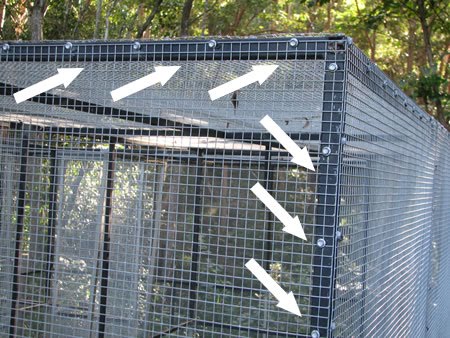
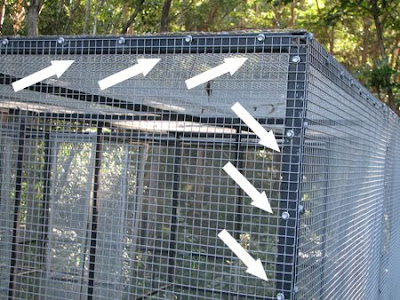
The ultimate goal is to achieve as tight and flat a weldmesh panel as you can. There's nothing daggier than a `bubbled' or floppy sheet of weldmesh on your aviary so take your tiome to get it right - you'll be looking at the results for years to come ;-) Achieving a `tight' fit is much easier when using 900mm wide sections than 1200mm wide sections, but a good tight and flat fit can be gained across both dimensions if done patiently and with care (two things that are usually lacking in my aviary building by about the third sheet :-() The image below shows the directional fixing of the tech screws - although, note that I have actually fixed the top row coming from the other end, not from the corner shown. If I had started from the corner shown the top row of screws would be working away from the corner - not towards it. Basically you just need to be working against the tension and pull of the opposing frame length.

One of the most common questions I am asked about my aviaries is `What do you paint them with?' It's a good question as most parrot owners are naturally averse to anything that might traditionally be considered `toxic' to their birds. In short, I use water based outdoor paint in low sheen/flat black. I only ever use either Dulux Weathershield or Wattyl Solagard. We've used both of these for 10 years now and it's completely harmless. For tidying up the hard to reach places that aren't easily covered with the paint roller, I use a water based spraypaint - once again in flat black. Water based acrylic spray paint can sometimes be hard to locate and is more expensive but it's the only option. We never use enamel based paints.

The next question about painting that I receive is `Why do you use black?'. The answer is that bare weldmesh sheet is highly reflective of light and hence visibility through the wire is very minimal. Aesthetically, bare wire will also start to show signs of corrosion and discolouration quite quickly due to environmental exposure. To give you an example of the visibility difference between unpainted and painted weldmesh check out the picture below that I took today of two adjacent panels - one painted, the other bare.


Make sure you make an effort to come along to the Parrots 2010 Convention in Brisbane on the first weekend of July. I will be delivering a full presentation there on outdoor enrichment aviary design and construction.

Sunday, March 14, 2010

Dragon Fruit - Does it `Glow'???


I recently picked up some Dragon Fruit at the local supermarket. It's one of those exotic asian fruits that the young register person always has to ask `What is this?' at the checkout. The next question is usually `What does it taste like?' - to which I admittedly have to reply, `I've got no idea - I feed it to my birds'. I then get the look - you know - the one that kinda suggests you must be nuts if you spend that sort of money on a piece of fruit that you don't even eat and instead, feed it to your birds! It does seem crazy but doesn't it feel great to add some new taste sensations into the food bowl of your birds? I'm not sure who gets the most out of it - them or me. If you really want to know though - it tastes awful (I actually tried it this time). One of those fruits that you might suggest - `Oh, it goes great with ice-cream', in other words, it tastes like dirt on its own and needs a good smothering of neopolitan before its edible :-)

Anyway, here's a question that I'd love to know the answer for... `Does dragon fruit glow?' That's probably not the right wording for that question but it's as close as I can get to what I'm thinking. You see, when I placed a chunk of it in the food bowl of my Amazon parrots they both reeled away in obvious horror. If you look at the flesh of dragon fruit it is a brilliant iridescent white (see pic above), the same sort of white you see on iridescent fungi and other things that `glow' in the dark. Given that our parrots can see colours in the ultraviolet spectrum that we can't, it got me thinking - what does dragon fruit look like to them? It obviously had some sort of `stay away' quality to it - they reacted the same way both days in a row that I tried to feed it to them. After a while, their appetites got the better of them but watching them slowly desensitise to their food bowl and finally take the plunge to grab a piece of less offensive food and make a run for it was an interesting study in behaviour - and perhaps the strength of the predatory defence of the humble dragon fruit!

If anyone knows what the ultraviolet or `hidden' colour spectrum of dragon fruit flesh is - please e-mail me! It also served as a good reminder to be observant of our birds responses to new food items in their bowls. Sometimes a change like that can result in an aversion to accessing their food for the day. No point in persisting with expensive fruit if all it achieves is a stressed and hungry parrot! I'll keep it for the Ice-cream ;-)

Thursday, February 11, 2010

New Education & Training Initiative at BBEVS

We are now offering special `Hands-on' sessions at the Brisbane Bird & Exotics Veterinary Service Parrot Behaviour Consult Clinics. These sessions will offer an opportunity for people interested in owning a parrot, but who have not yet made the leap, to develop an introductory understanding of the essentials of new parrot ownership. The consult will cover a discussion of enclosure, diet, and enrichment needs of companion parrots, an overview of the essential resources required by the new parrot owner, and an opportunity to develop some basic `hands-on' handling and training skills with one of our parrots. Clients will also be able to fire away with questions on selection, acquisition and suitability of parrots as pets. This will absolutely be the best point of access to information that will hopefully set the prospective parrot owner up to succeed. Most of you reading this will already be parrot owners so... I am hoping that if you are communicating with anyone interested in taking on the challenge of a parrot as a companion animal (and if they live in SE Qld obviously!), then please refer them to this service - it can really make the difference for people making an informed decision. If you are a breeder, then why not value add one of these consult sessions in as a pre-purchase service. If anyone is interested in finding out more about this service and/or would like to make a booking for one of these `pre-purchase' clinic consultations then please e-mail me directly via jim@pbec.com.au to discuss your goals so that I can tailor our session as directly as possible to your needs and situation. The sessions are available only on the third Saturday of each month at Brisbane Bird & Exotics Veterinary Service - Macgregor, Brisbane. To add to the incentive - You can also select from one of the parrots below to use as your `trainer' bird!!! (There may be times when one of these guys isn't available but just get in touch and we'll see what we can organise ☺).

Our `Trainer' birds...

`Lola' - Yellow-crowned Amazon


`PJ' - Black-headed Caique


`Wobbles' - WA Galah


`Nandy' - Nanday Conure


`Maya' - Green-winged Macaw


`Alphonso' - Yellow-naped Amazon


Feeding Our Parrots Well - New DVD


Last week I received a copy of a new DVD that has been produced by Kris Porter and Pamela Clark, titled `Feeding Our Parrots Well'. I finally had the chance to sit down today and have a full viewing of the DVD. There's not a lot out there these days that gets me thinking differently about my own approach to my parrots but this DVD really did get me excited and challenged to come up with new variations on not only what I am feeding my parrots, but also the way I go about preparing their food. The DVD runs in the same format as a classic `cooking show' - with Pamela and Kris presenting their `recipes' at the kitchen counter, complete with the `I prepared this earlier' timesavers :-) The feeding recipes are wonderfully explained, clear, simple, and not only that - each DVD has an accompanying recipe book so you can recreate everything using the good old fashioned cookbook approach!

Don't expect to see parrots on this DVD - it's all about you, and motivating you to get thinking creatively about preparing fresh, super nutritious, and healthy ways of feeding your companion birds. I was super impressed by Pamela's explanation of converting parrots from seed based diets to a healthy one. She really presents an honest and realistic approach to this in the context of her own experiences with her Moluccan Cockatoo. I personally loved the DVD and will be recommending it via my website and workshop education. For more information on Kris Porter's work on enrichment education make sure you take some time to check out her website at http://www.parrotenrichment.com - Great Stuff! For further information on Pamela Clark check out http://www.parrothouse.com/pamelaclark/

Tuesday, February 2, 2010

All Red African Grey


Well - here's something you don't see every day! I'm not usually interested in mutations in aviculture but this one is just too bizarre to pass up sharing around. What impresses me is that this mutation has come about through a nine year process of selective breeding and is a pure genetic mutation of the species - prevalent in its partial form in the wild. You can check out some video of it at http://www.redafricangrey.com/

Designing & Building Enrichment Aviaries - Part 2


Well, thanks largely to the weather here in SE Qld, I've only managed to make some small progress on the new outdoor enrichment aviaries that will house our Lories. Last week I was able to get the three roofs wired up. This was a good hurdle to get over as doing the roofs is my least favourite part of wiring conventional aviary frames. I managed to do an OK job on two of them but completely botched the last one. All I can hope is that anyone who sees them will be too busy looking at the birds to take any notice of my dodgy roof wiring. I'll have some more `tech' info on the tools and materials I'm using in the next update - and some closeups of the technique used to get the wire nice and tight. The process of building these will hopefully feature in one of my presentations at Parrots 2010. Ya gotta be there people! In the meantime - if you have any questions about building an aviary for your pet bird then get in touch with me via jim@pbec.com.au. Perhaps I'll write up the response as a post here so that everyone can share in the learning.

Parrots 2010 Convention - Program is complete!!!


As some of you may already be aware - the Parrots 2010 Convention program has recently been released to everyone who registered for early bird interest in the event. Registration forms have also been distributed to these people and registrations have already started flowing in! As the guest speaker coordinator for this event, and the person responsible for putting most of the program together, I have to say that I'm pretty darn proud of what we've put together and the opportunities it will provide for delegates to really deepen their knowledge and understanding of parrots in the wild, in aviculture, and in behaviour and training. The 3-day program features an Aviary Tour, Meet & Greet sessions with the speakers, 22 lectures and presentations from 16 different speakers over the weekend and a special Conservation Dinner. There has never been a parrot convention of this scope and kind held in Australia before.

The event is scheduled for Friday July 2nd to Sunday July 4th 2010 and will be hosted at the Bardon Convention Centre, just 6km from the Brisbane CBD. If you would like to receive a full colour PDF copy of the program then please e-mail me via jim@pbec.com.au and I will be happy to answer any questions of enquiries.

Looking forward to seeing many of you at this event - Don't miss it!!!


Sunday, November 8, 2009

Next ABK Issue – it’s on `target’ for a great read ☺

I hope that some of you bought the latest ABK Magazine and had a chance to read about my experiences with Lola, my Yellow-crowned Amazon parrot. I think it’s a good little story and one that shares the simple fact that it doesn’t matter how experienced you are, or how much you think you’re prepared, life with parrots is always full of new challenges and reminders that you’ve still got a whole darn lot more to learn. If you didn’t get the mag, and therefore didn’t read my article, well, ah, may your parrot poop on your best shirt tomorrow! Anyway – I’ve just sent off the Pet Parrot Pointers column for the Dec/Jan issue, which will be out in the second week of December. I thought about doing some kind of daggy `What to buy your parrot for Christmas’ thing but I just couldn’t. Read `Bird Talk’ for that – guaranteed to have a parrot somewhere in an issue at that time of year wearing a Santa hat or some other barf inducing prop (God I hope they Photoshop those images). Nope – I thought I’d give the gift that keeps on giving and write up an article on Target Training J Hey, maybe that’s what you can buy your parrot for Christmas – a Target Training stick! One of those super-dooper telescopic ones that extend out like a TV antenna (for those of you who are pre-plasma generation and actually know what an antenna is). Actually those target sticks are pretty neat – I have one and love it. You can pick them up from http://www.myparrotshop.com if you’re in Australia. Either that or just nick a chop-stick next time you’re out feasting on a Sweet ‘n Sour dish at your local greasy spoon.

One of the applications of stationing a parrot to touch a target that I’ve been applying is with Lola – the aforementioned Amazon Parrot. She’s never been keen on tactile handling, always been a little on the averse side to hands, and not been one for a good old ruffle of the nape feathers. With a little use of the target and pairing some approximations of reduced proximity of my fingers towards her head, then a touch, then increasing touch duration, she’s come around and is now a bit of a glutton for a good old preen and cranial massage J Nice work Jimbo – and thanks for the patience Lola! The other pic is PJ, my Caique. He used to go into pet packs no problemo, but I’ve been slack in keeping this up. A good reminder about training some of these behaviours – use it or lose it! Anyway, I’m back to working with him and getting him re-acquainted with the scary plastic box again. The target helps and hopefully this time we’ll keep it up. Read more in the ABK Dec/Jan issue. Available at newsstands absolutely everywhere on Earth from mid-December J


Wednesday, July 22, 2009

Welcome to the PBEC Blog...


Time... Don’t we all wish we had a heck of a lot more of it? The fact that I’m only just now writing a `first Blog’ for the PBEC website, more than 6 months after the site went live, is a pretty good indication of just how time poor I am these days. This was actually supposed to be a kind of `take it easy’ year for me – you know how those New Year’s resolutions go, a few drinks and you’re waxing all nostalgic about the days when you took the time to surf more, go birdwatching more, walk the dogs more, hang with the parrots more, sit around and do absolutely nothing more! I had planned from that moment to make a commitment that 2009 would be a year to focus solely on teaching, parenthood, delivering just the one parrot workshop, and finally putting a serious dent in a book project that I am desperate to complete. As the year has unravelled though, it’s turned out to be busier, more demanding, and at times more challenging, than my pathetic little effort at `commitment’ to the simpler life could possibly allow. Through it all though, the first six months of 2009 have offered some of the richest and most positively reinforcing times for what I do as a parrot educator. Right now I’m super inspired to keep the behavioural momentum flowing and share some insights from more than 15 years working with parrots via the words found here. Hopefully from time to time that sharing will be of benefit and interest to you, the reader or casual observer of what’s going on in the parrot world. At times it might also be challenging but hey, if you don’t appreciate a good challenge then you probably wouldn’t own a parrot right?  Even though I’m still getting my head around exactly what a Blog is all about, I plan to use my energies in this forum to cover a fairly diverse range of issues, food for thought, and personal comment related to life working with parrots, bird owners, and doing my best to be an exponent of positive reinforcement principles. Better late than never? I hope so ;-)