Showing posts with label parrot behavior. Show all posts

Sunday, May 30, 2010

Pan-Pac Veterinary Conference


Last week I gave a series of lecture presentations, followed by a practical parrot training workshop, at the Pan Pacific Veterinary Conference that was held in Brisbane. Lecturing to veterinarians from a variety of interest groups within that profession can be a challenging task - particularly when it comes to discussing approaches and methodologies of behaviour consulting with parrots. I suspect that many of the traditional paradigms of thinking for the behaviour management of pet birds persist within the veterinary field. However, the group I lectured to really did seem to be wonderfully receptive to a more progressive approach that embraced Applied Behaviour Analysis and Functional Assessment of behaviour. I noticed quite a few `light bulb' moments occur throughout the day that served as great positive reinforcement for me.

Whilst I am certain that the vet group came away from the day with a lot of great, practical, information and advice - I certainly came away with a deeper appreciation for some of the time constraints that our veterinarians face in their clinic consultation work. What blew me away was that for many of the vets I spoke to informally during the day, a standard consult time allocation was just 15 minutes. Not a lot of ground you can cover in that amount of time if we're talking about the complexities of parrot behaviour! There was a strong sense that dealing with discussions on parrot behaviour with clients was too overwhelming and time consuming. It challenged me to come up with ways to support the vets in being able to deliver small, but potent, pieces of information on behaviour to their clients. For most of them, I think the criteria for what they might consider success in working with a client on parrot behaviour issues was too high. Just as we see when we raise the criteria for our birds too high, too soon, with our own expectations of ourselves we often see a loss of behavioural momentum and a diminishing of opportunities for learning if we fail to recognise the small approximations of achievement that we make before the end `goal' is reached. It truly was a great opportunity for me, particularly coming from outside of the veterinary community, to work with such a great group of professionals. My sincere thanks to Dr. Deborah Monks for organising the opportunity and to Dr. Melinda Cowan and Dr. Kim (Sorry Kim - I didn't get your surname!), for helping with all my `gear' and birds. A very special thanks, to Phil Ghamraoui who helped as a second trainer for the practical session. Finally - thanks to my `teachers' for the day - PJ my Black-headed Caique, Lola my Yellow-crowned Amazon, and a gorgeous little Meyer's Parrot that I will talk about in a future post.

Monday, April 26, 2010

Enrichment Aviary Project - Update

It's been a while since I posted about the new aviary complex that I'm working on to house some of our parrots. I've been hard at it again this past weekend and with the wiring of the frames now completed and painting started I thought I would share a few insights into these two aspects of the construction.

First up, let's talk about attaching weldmesh to the aviary frame. For a novice or someone inexperienced this can end in a really poor looking aviary and an awful lot of frustration. A couple of pointers that might help when you are applying the weldmesh sheets are:
  1. When placing the weldmesh sheet against the frame, make sure that the `bow' (created by the wire having come from a roll) is directed away from the aviary. Think of it as placing the weldmesh sheet so that it forms a convex arc away from the frame - rather than a concave curve towards the frame.
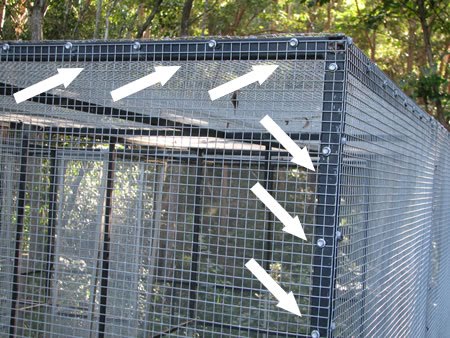
  2. When drilling in the tech screws, make sure that each screw is placed tightly into the corner of each weldmesh square so that as you work your way out from the corner of the frame, the mesh is being pulled in opposing directions along the lengths of the frame. Drilling the screws in equidistant along the frame lengths will also assist in achieving a more uniform and `tighter' fit.
The ultimate goal is to achieve as tight and flat a weldmesh panel as you can. There's nothing daggier than a `bubbled' or floppy sheet of weldmesh on your aviary so take your tiome to get it right - you'll be looking at the results for years to come ;-) Achieving a `tight' fit is much easier when using 900mm wide sections than 1200mm wide sections, but a good tight and flat fit can be gained across both dimensions if done patiently and with care (two things that are usually lacking in my aviary building by about the third sheet :-() The image below shows the directional fixing of the tech screws - although, note that I have actually fixed the top row coming from the other end, not from the corner shown. If I had started from the corner shown the top row of screws would be working away from the corner - not towards it. Basically you just need to be working against the tension and pull of the opposing frame length.


One of the most common questions I am asked about my aviaries is `What do you paint them with?' It's a good question as most parrot owners are naturally averse to anything that might traditionally be considered `toxic' to their birds. In short, I use water based outdoor paint in low sheen/flat black. I only ever use either Dulux Weathershield or Wattyl Solagard. We've used both of these for 10 years now and it's completely harmless. For tidying up the hard to reach places that aren't easily covered with the paint roller, I use a water based spraypaint - once again in flat black. Water based acrylic spray paint can sometimes be hard to locate and is more expensive but it's the only option. We never use enamel based paints.

The next question about painting that I receive is `Why do you use black?'. The answer is that bare weldmesh sheet is highly reflective of light and hence visibility through the wire is very minimal. Aesthetically, bare wire will also start to show signs of corrosion and discolouration quite quickly due to environmental exposure. To give you an example of the visibility difference between unpainted and painted weldmesh check out the picture below that I took today of two adjacent panels - one painted, the other bare.


Make sure you make an effort to come along to the Parrots 2010 Convention in Brisbane on the first weekend of July. I will be delivering a full presentation there on outdoor enrichment aviary design and construction.

Thursday, March 4, 2010

Bird Retailers & Wing Clipping

OK – here’s a contentious one, but no point in fence sitting from my perspective. I recently stopped in at a major bird retailer in Brisbane to pick up a bunch of bird supplies while I was on my way to my monthly consult sessions. Usually I don’t have much time to stop and look at the birds in retail outlets but this time I did, as it is the time of the year when there are a lot of young baby parrots available and it is always interesting to see what is entering the companion parrot community. Whilst I know that there are many highly responsible bird retailers and very good outlets for acquiring a pet parrot, what I saw in this particular store really bugged me. Every single handraised parrot waiting for sale to a pet home was clipped not one exception. None of those birds had been offered the opportunity to develop their flight skills, coordination, confidence and independence. All were recently weaned and obviously had more than likely never actually `flown’. Whilst I obviously don’t condone the clipping of a parrot’s wings, I have to accept that there is no law to prevent it or legislative authority to monitor it or set guidelines for it, therefore I have to live with it as a reality of what we see in the bird world. But geez folks – can’t we at least give the new owners of these young birds that are sold in pet stores the option??? How hard is it to keep the young birds fully feathered, provide some informed and responsible point of sale pros and cons on wing clipping, offer advice on training and accessing training resources on managing a flighted bird, encourage the buyer to visit a qualified veterinarian to have any clipping done if it has to be done, and most of all, give the parrot a chance to be a parrot.

I then had the unfortunate experience of standing beside one of the sales assistants as a father and son team came in to buy a budgerigar as a pet. Having no handraised or tame budgies to choose from, a young bird was selected from the flock and promptly clipped. Not a progressive clip method used there either – the good old full primary and secondary chop. The sales assistant justified the procedure as nothing more than a `haircut’ – obviously using the analogy to explain that the clipped wings will be replaced over time by new ones. I just can’t seem to remember not being able to walk out of the salon the last time I had a trim. Mind you – my hairdresser is licensed to sell alcohol so a visit there is perhaps not without the potential for a major modification of my physical capabilities. Hmmm.

I think it’s about time that some guidelines and best practice recommendations for the physical modification of parrots within retail outlets was implemented. Parrots presenting with behaviour management issues that also have clipped wings account for the highest proportion of birds in the demographic of my clients. It’s more of a precursor to behavioural abnormalities arising in companion parrots than having them flighted and presents a significantly more complex set of circumstances to develop successful management strategies for – particular birds that are over-dependent or have established feather picking behaviour.

What we need to be clear on is this – keeping a parrot flighted can be successfully managed. Yes, it’s more work, yes, there may be some challenges to overcome, but let’s at least give these birds a start in life where being clipped is not a fait accompli and they are given the opportunity to learn to adapt to a captive life whilst retaining their full complement of physical capabilities.

One final frustration with this particular retailers approach to the selling of handraised parrots as pets was the lack of suitability of some of the species for sale. It seemed as though their only criteria for having a bird available for sale as a pet was that it was handraised - didn't seem to matter what species it was. The most glaring example of this were Pale-headed Rosellas for sale as pets. Honestly, as much as I dearly love the Platycercus for all of their gaudy beauty, I couldn't think of a species more unsuited to life within the confines of a small indoor cage for most of the day. Not only is their lack of adaptability to close confinement a major concern, they don't tolerate tactile handling in the form of head scratches and mature birds have a strong behavioural tendency towards intense territorial aggression that I have yet to see not hold true. I'm also yet to find a pet parrot owner that doesn't consider head scratches and that sort of close tactile interaction with their birds a very desirable reason for them keeping a companion parrot. It's a little like selling a dog that doesn't tolerate being patted. Now before anyone suggests that `there's a right home for every bird' - do you honestly think the retailer is going to screen buyers that walk in wanting a pet parrot and make the mistake of picking the Rosella because blue and yellow are their favourite colours??? Therein lies the problem folks. Betcha we'll see a couple of Pale-headed Rosellas up for grabs in the Weekend Shopper some time later this year - advertisement might run something like this... (additional info in brackets not supplied in ad)

`Pale-headed Rosella. Handraised and wIll make great pet (didn't for us - but might for you!) Owner moving interstate (to get as far away from nightmare parrot as possible). Comes with cage and bag of seed (hates the cage but loves the seed). Whistles (on..and on...and on.... until you let it out of aforementioned cage that it hates) Make an offer (folks, we're desperate, if you're here by 9am we'll just give it to ya)'. Hmmm.


A young and recently weaned Blue-fronted Amazon. Fully flighted, engaging, challenging - and manageable just as he is!

Monday, February 1, 2010

Internet Chat Groups - Good for ruffling feathers but what else???


I was prompted recently to think about just how helpful the whole Internet chat group scene is for parrot enthusiasts when a friend of mine was explaining to me that she was booted off one. Her experience intrigued me as it often seems to be that many Internet discussion forums within the companion parrot community inevitably head down the path of conflict - much like the cartoon above if you're wondering why it's there ;-) I actually used to have a full discussion forum board linked to my original website and community initiative - `The Companion Parrot Support Network'. The `CPSN' (as we abbreviated it to at the time) website featured a free library full of articles, video clips of parrots in the wild, a page dedicated to working through behaviour management issues - the full deal. We even used to have `gatherings' - just casual opportunities for parrot owners to get together, network, share experiences etc. It was pretty neat for its time (it went online about 8 years ago and finished up in around 2006 or early 2007 maybe - I can't remember now). Anyway, we had a great discussion forum integrated into the site and I still have the odd person (we're all odd if we keep parrots BTW) tell me how much they liked the site and the way the forum operated. I can only remember a single incident where someone posted something on that discussion board that really should have been thought about a little harder (ie - not said at all) in all the years it was running. It was a good bunch of people who were involved in it that's for sure - many of who are still friends to this day. These days, I simply don't have the time to get involved in community forums as my life is beyond full already. It's been quite a few years since I have had anything to do with that side of the companion parrot community so I thought I would go take a look around and see what companion parrot folks talk about these days, what's topical, what's contentious, what's interesting, but most importantly - I was hoping to see that there had been an evolution in the approaches people were taking towards discussing the behaviour of their companion birds.

I realise that there are many discussion forums online that are incredibly supportive and important avenues for the sharing of information and experiences in keeping parrots. I certainly have browsed through a couple that seemed to have a very cool, positive, and family like vibe. Unfortunately, there were a few that, well... kinda sucked (I teach teenagers folks so occasionally I do slip into that mode of describing things). Where most of these forums seem to come unstuck is in the way they approach the discussion of `behaviour'. They can be wonderful little access points for people to share about random experiences, diets, where to go to get the best deal on the latest enrichment toys etc but man, that whole `evolution' hope I had towards the way people are addressing parrot behaviour, on some discussion forums (not all!), just seems to have stalled somewhere in the Cro-Magnon stage of the developmental timeline. Here's what I kinda think on the whole parrot discussion forum concept when it comes to the way these forums approach dealing with both experience sharing and advice giving on behaviour, and perhaps where I would dare venture to suggest areas for improvement...

The most common pathway that some companion parrot discussion forums seem to go down is to create a never ending stream of threads based on `He said...’, `She said...’, second-hand, third-hand, no-hand, advice and suggestions on parrot behaviour that almost always lack a common and definable reference point. These never seem to get anywhere and rarely solve a situation for the person asking the questions, whilst inevitably generating differences of opinion and conflict between those keen to get in on the advice giving race. I'm pretty confident that we have reached a point in our knowledge and understanding about behaviour where we can start to address such questions on forums from a common framework of understanding about how behaviour works, and use a common language to describe behaviour we observe. I think the approach that such forums need to take is to dispense with the traditional, communal paradigm of `let’s all put our 2 cents worth in here and hope that something makes sense’. To me – that’s no different to the John Edward technique of throwing out carefully crafted non-specific scenarios until eventually one sticks and people think he can speak to the dead! When people are desperate for help, the gullibility element is unfortunately always high. Most of the time, that approach is just embarrassingly off the mark and usually just serves to perpetuate myths, give credence to poorly considered generalisations, and continue the lifespan of outdated home spun remedies or supposed `reasons' for why a parrot just behaved the way it did.

In my view, a good, progressive forum will simply address all behaviour issues raised using the same, simple, and logical framework for working through the problem. As an example, let’s say someone asks a question about their parrot, who just bit them a few minutes ago and they've rushed to the keyboard to get an answer from the cyber experts about why and sympathy from those who are always keen to offer it. Instead of going down that `2 cents worth' path, a good forum will start by challenging that person to access the freely available online literature written by the likes of Dr. Susan Friedman, Steve Martin, Barbara Heidenreich (or... me, check my site - I have some freebies too :-), or one of a number of excellent authors who have made their works freely available online. This literature follows the same guiding principles of using an Applied Behaviour Analysis approach to evaluating behaviour and sets a common, scientific ground for everyone to work from. After that, the discussion group will then ask them if they have accessed printed material in the form of Barbara Heidenreich’s `Parrot Problem Solver’ or `Good Bird’. It will then ask them to reconsider their experience with their parrot in the context of the information given to them in those resources. Advice and strategies can still be given, but once again, these should be drawn from the literature we have available so that everyone is working from the same page, and only after the person has identified some possible strategies to work through the issue themselves. When we stick to referring to information that is `in print’ then it becomes less open to the dilution, re-interpretation, or complete misrepresentation that so often happens when we refer to word of mouth advice we hear. I’ve lost count of the number of times people have completely misquoted, taken out of context, or misrepresented what I have said in workshops or privately while trying to regurgitate that information to others. They always mean well but... The example I even set myself is simply `go to the source’, it’s all there in black and white and there’s no confusion in that. Hence why my own website encourages people to read all the `free’ stuff by a range of sources that I have put there for them - before they come see me, 'cause I charge :-). It works best - and there's nothing more satisfying for me than to work with a client who is committed to `self-help' first. They're inevitably the ones who have success.

If we all realise that the laws of behaviour are universal, clearly defined, and easily understood, and when we all work from the same consistent reference point, then we tend to have `real’ success in managing the behaviour of our birds and giving support to others. If we continue to reinforce apathy towards reading the brilliant work that is already out there, and continue to reinforce a lame reluctance to part with 30 bucks or so to buy a book like Barbara’s two volumes, then we will forever continue to have discussion forums where someone is always the `expert’ and there’s a sucker born everyday who will eat up their advice regardless of how valid it is - simply because it’s free, convenient, and in keeping with our cultural divergence towards the quick-fix, `drive-through’ solutions to all of our problems that society is so hell bent on providing. If I can suggest one thing after working with parrots and their behaviour for more than 15 years it's that rarely are there those nice little `quick-fix' moments. I wish it were so.

If you want to be a part of a good internet discussion forum for parrot owners then encourage people seeking support for problem behaviours in their parrots to develop self-help strategies, and don't allow them to develop dependencies on waiting for someone out there in the internet community to just tell them what they want to hear. Internet forums can unfortunately be the best places in the world for reinforcing lazy approaches to education and failing to promote the development of a progressive understanding about how to approach the behaviour of companion parrots. For those of us who know better, we need to make sure that we aren’t inadvertently reinforcing that through our own participation in the whole convoluted process of vague approaches to dealing with behavioural issues. We can do better.

If you are a member of a really good discussion forum that you think manages the handling of giving people advice on the way their parrot behaves using a similar framework to the one above then let me know. Send me a link to thread that is representative of that approach, I'll check it out, and if it rocks then I'll link it here on the blog!

Monday, January 4, 2010

Designing & Building Enrichment Aviaries

At the forthcoming Parrots 2010 Convention in Brisbane (July 2nd to 4th) I will be giving a presentation on designing and building enrichment enclosures for parrots. The key focus will be on creating safe and enriching outdoor flight enclosures for pet birds. Over the next couple of months I thought I would share some snippets of what will be featured in that presentation via my Blog. What I will be aiming to do is to post progress photos to show the construction of a set of three flights that I am currently building. The first couple of images below show two different angles looking at the front of the complex. The complex will be composed of three flights, each measuring 3.6m long x 1.8m wide x 2.1m high. They will be configured with a central walkway to service all three flights. The birds that will be housed in these enclosures will be various Lory species but the design could accommodate any small to medium parrot, up to the size of an Amazon. I would love for this next set of Blog entries to be interactive so if you have any questions about aviary design or construction then please contact my via e-mail at jim@pbec.com.au I won't be able to personally reply via e-mail but what I will hopefully be able to do is to share your question and suggest an answer via these Blog posts.

So far we have welded the frames for the three enclosures and the additional walkway. To do this we used 25mm square RHS box galvanised tubing. Always use galvanised tubing for aviary frames to minimise rust corrosion and always use spray gal on the welded corners after smoothing out the welding with an angle grinder. Leaving bare tubing exposed to the elements without some form of galvanising protection will result in rust forming within weeks.

Now that the welding stage is complete, we have started to wire up the frames. We were lucky in being able to buy enough Waratah WeldMesh to complete this project before BHP/BlueScope Steel stopped production. This is the safest and absolutely the best weldmesh for aviary use and I'm very concerned about the future of obtaining decent quality wire now that Waratah Mesh will be unavailable. I have heard that a few aviculturists around Australia stockpiled it before it ran out. Wish I did the same to be honest. We now have to try and source good quality, safe wire from China. I've heard that some decent quality stuff is coming out but nothing that compares to Waratah. A huge BOOOOO!!! to BHP for leaving aviculturists in the lurch by no longer providing us with the best wire in the world for parrot enclosures.

Our preference for wire is 12.5mm square mesh size We used to use 25mm x 12.5mm square mesh but given that we live in a fairly high snake density area and have had problems with snakes in the past we don't use it anymore. You would be amazed at the size of carpet python that will squeeze through inch by half inch mesh!!! Touch wood, we're yet to have a snake make it through the 12.5mm square wire and we know they try because I've relocated 4 off the aviary roofs in the last two years. Better on the roof than under it me thinks :-). We use ~1.3mm gauge thickness as it is easier to manage and in my experience, we never have problems with birds `working' it and damaging it. You do have to be careful with perching and use some common sense when securing perches to 1.3mm gauge wire as it can tear if too much strain is placed on it. In the next post I will talk about securing wire to the frame and give some tips on that.


Wednesday, July 22, 2009

Welcome to the PBEC Blog...


Time... Don’t we all wish we had a heck of a lot more of it? The fact that I’m only just now writing a `first Blog’ for the PBEC website, more than 6 months after the site went live, is a pretty good indication of just how time poor I am these days. This was actually supposed to be a kind of `take it easy’ year for me – you know how those New Year’s resolutions go, a few drinks and you’re waxing all nostalgic about the days when you took the time to surf more, go birdwatching more, walk the dogs more, hang with the parrots more, sit around and do absolutely nothing more! I had planned from that moment to make a commitment that 2009 would be a year to focus solely on teaching, parenthood, delivering just the one parrot workshop, and finally putting a serious dent in a book project that I am desperate to complete. As the year has unravelled though, it’s turned out to be busier, more demanding, and at times more challenging, than my pathetic little effort at `commitment’ to the simpler life could possibly allow. Through it all though, the first six months of 2009 have offered some of the richest and most positively reinforcing times for what I do as a parrot educator. Right now I’m super inspired to keep the behavioural momentum flowing and share some insights from more than 15 years working with parrots via the words found here. Hopefully from time to time that sharing will be of benefit and interest to you, the reader or casual observer of what’s going on in the parrot world. At times it might also be challenging but hey, if you don’t appreciate a good challenge then you probably wouldn’t own a parrot right?  Even though I’m still getting my head around exactly what a Blog is all about, I plan to use my energies in this forum to cover a fairly diverse range of issues, food for thought, and personal comment related to life working with parrots, bird owners, and doing my best to be an exponent of positive reinforcement principles. Better late than never? I hope so ;-)