Showing posts with label companion parrot. Show all posts

Sunday, August 4, 2013

Final 2013 Workshops - Sydney & Gold Coast


Just a couple of date claimers for my final workshops for 2013…


Workshop Title:  `The Training Toolkit’
Date: Saturday September 7th
Venue: Animal Referral Hospital – Homebush, Sydney.
Time: 9:00am to 1:30pm
Presentations:

  • Session 1: The Training Toolkit
  • Session 2: Nutritional Influences on Parrot Behaviour (Dr Stacey Gelis)
  • Session 3: What’s in it for me? – Motivating parrots for training success
  • Session 4: Training Troubleshooting – Tips for successful training and behaviour change management

Cost: $95
Registration Information: Please contact seminar@arhvets.com or phone 02 9758 8880 (Registrations close August 31st)

Workshop Title: `Annual Currumbin Wildlife Sanctuary Companion Parrot Workshop Day’
Date: Saturday September 28th
Venue: Currumbin Wildlife Sanctuary – Gold Coast
Time: 9:00am to 4:00pm
Presentations:

  • 21st Century Approach to Companion Parrot Keeping
  • Environmental Enrichment
  • Diet Management
  • Practical Handling & Body Language Interpretation
  • Behind The Scenes – Free Flight Bird Show
  • Behaviour Management
  • Q&A

Cost: $135 ($95 for second household member)


`Hey - Get some education!!!'

Friday, July 5, 2013

The 80/20 Rule


In my last post I talked about some simple options for foraging foods that can encourage parrots to spend more time feeding in functionally relevant ways that match how these little guys are biologically built to behave. A few years ago I published an article in Australian Birdkeeper Magazine that discussed the disparity between variability vs predictability in a parrots daily experience set in captive environments compared to natural environments. It’s what I call the `80/20 rule’. No hard and fast science here – just an anecdotal generalization of activity budget and what a parrot is likely to experience on any given day either in the wild or as a pet in someone’s home that is simple enough for everyone to get the picture that life in the wild is a heck of a lot more variable than life in the living room.  

The simple equation suggests that a parrot in the wild is likely to have a high degree of variability (that’s the 80%) and low degree of predictability (that’s the 20%) in its daily experience set. Conversely, the captive parrot is likely to experience a low degree of variability (20%) and high degree of predictability (80%) in its daily experience set. This sets up the challenge to address the disparity and bridge the gap in that 80/20 ratio between predictability versus variability. It’s the key to long-term behavioural success in our birds. A simple way to start is to categorise all of the experiences your parrot has in a day – eg, feeding, bathing, social interaction, exploration, out of cage, in cage, on playstand etc. Think of alternative ways that each of those experiences can be presented and how you can reduce their predictability on a daily or even weekly schedule. In the next post I will illustrate one super simple way that you can make change the norm. Change and Choice – two great words to keep in mind when setting the environment up for your parrot to succeed and doing something proactive about that 80/20 rule.

Five Fab Foraging Foods


After nearly 20 years of daily parrot feeding I seriously still get a buzz from seeing my birds getting stuck into the fresh food that I prepare for them daily. Cleaning and re-perching, yep - that's a chore, feeding - definitely not. I have written about the value of foraging foods in a number of past blog posts but I wanted to revisit the idea with `5 Fab Foraging Foods’ – stuff that anyone can grab from their local produce and supermarket that get parrots working for food in ways that better replicates the functional foraging behaviours we observe from them in the wild. 


  1. Fresh Figs – Expensive little fellas but packed with gooey goodness. These represent everything that is good about a true forage food – inedible external layer hiding seed filled fleshy delight with the right texture to appeal to most species. A nice idea is to use a knife to `score’ the outside and just feed whole to let them do the rest of the demolition job on it. 
  2. Sugar Snap Peas – Another pricey piece of produce but again, a great replicator of nature’s parrot perfect packaging that demands some work and perseverance to get beyond the fibrous pod and into the peas inside. 
  3. Passionfruit – As with fresh figs, the best way to feed these to motivate work is to score the fruit casing with a knife and let them do the rest. I actually find that my birds don’t seem to eat much of the passionfruit at all. But the sight of an obliterated mess of purple and gold tells me that they whilst there was probably no nutritional value to be gained they had plenty of fun doing `stuff’ other than making noise and pulling out feathers.
  4. Chillies – Parrots lack the capsaicin receptors that result in us humans experiencing the sensation of `heat’ when eating peppers. Packed full of vitamins they can be a great addition to the daily diet. In all the years I have been feeding parrots I have seen every variation on the theme when it comes to consuming foods like chillies. Some eat the flesh, some only eat the seeds, some show little interest. Worth persevering and trying different colours as well to pique their interest. 
  5. Seed Sticks – Yep, not kidding. I’ll probably be lambasted by all the Parrot Police out there who want to rave about ridiculous restrictions on feeding anything not derived from ritually blessed organically certified soils of the hippy hinterland or picked from trees facing the mystic light shards of the northern summer solstice. But seriously, these humble little original bird treats are cheap, convenient, novel fun – especially for parrots that rarely get exposed to seed in their regular diet. In most cases very little is actually consumed and they really can be a highly effective redirector for destructive behaviour – particularly useful to have handy when you need a little quiet `busy’ time from your parrot. Just be sensible with the stick selection and the way you use them; choose the varieties with minimal sunflower seed, avoid the wire stick versions and only use the type shown in the pic above (Trill and Bird Munchies are best), only provide with a purpose (not as a substitute for the more nutritionally beneficial items of their daily food intake) and present for short windows of opportunity to access instead of leaving them in the cage for extended periods of time.

Tuesday, September 20, 2011

The Tender Lovin’ Towel Hold

I was going to start this post off with `It never ceases to amaze me…’ but ya know what? When it comes to hearing about really outdated and downright destructive advice given to parrot owners it really doesn’t amaze me - I've heard it all and keep hearing it.  The tragedy is that bad advice is common advice – good advice is still the exception. The following is an excerpt from a recent e-mail I received that demonstrates the point I make fairly regularly here about the perpetuation of bad behaviour management information and improper handling techniques with parrots. The context is a 10-year-old Galah that has completely lost trust in human hands…

`We took him to (location removed – as tempting as it is to name and shame) and the handler there advised that this can be normal behaviour in male birds preferring a female owner. We were also shown how to use a towel to handle him properly and to scratch him on his head while holding him. Unfortunately he won't even let (name removed) scratch him then - he just keeps trying to bite him.’

Ahhh – the good old fashioned `Towel Hold’. That old chestnut. Love the way the parrot owner referred to the person giving the advice (and demonstration!) as the `handler’. Anyone getting visions of a burly kaki clad lion `tamer’/`bird whisperer'. I bet he had a multi-tool in a leather pouch on his belt too. Ahh... maybe that’s just my colourful imagination. Anyways - nothing like a relationship building session that entails wrapping your petrified polly in a towel like a big old carpet python and giving him some tender lovin’ strokes on the head to let him know that it’s all good in the hood eh? And all involved are still surprised at why such a strategy resulted in a parrot that wanted to bite them and still won’t go near them? I’m all for a good cuddle every now and then but I’m pretty sure if that involved being straight-jacketed and patted on the head repeatedly I’d probably develop a wee bit of an aversion to that experience after a while. Wouldn’t matter how many sweet nothings were being whispered in my ear. The above excerpt isn’t unusual. Last month I had another client who had purchased an Alexandrine from a pet store in Logan (Brisbane south) under the assertion that it was eating food fine and only give it some formula if it’s hungry (Huh? It was a 10 week old Alex!) and it would make a fine `friend’ for their existing pet Green-cheeked Conure (Wha?). No prizes for guessing the outcome there.

I want to note that not all bird stores fail in properly educating their staff on non-invasive, trust building approaches to behaviour management and sound husbandry information. Indeed, at my recent seminar day in Sydney, a prominent Brisbane bird retailer had basically their whole bird department team in attendance! Such a commitment to the professional development of retail staff is to be applauded (three cheers to Pet City Mt Gravatt and the staff in attendance – inspirational stuff! I’ll spend my hard earned there thanks). The problem is that proper staff training at bird retailers simply doesn’t happen outside of a few exceptional stores. The retailers can cry all they like about not being able to afford PD for their staff but I’m not sympathetic. It doesn’t cost anything to tell staff that instead of giving crap advice on behaviour and training they should instead refer the client to properly qualified sources. They stand to gain more from that person seeking out and obtaining information that actually `works’ and improves their relationship with their bird than potentially lose that client as a result of them implementing damaging advice and making the situation worse rather than better. With resources such as those produced by Barbara Heidenreich (www.goodbirdinc.com) easily available through multiple sources in Australia there’s a perfect opportunity to sell products that have sound advice rather than attempting to be the source of solutions that are a bad reflection of our past approaches to parrot care. That for my mind is a win-win approach – income generated for the retailer and a sense of responsibility for self-education placed back on the bird owner. 

Got a similar tale to tell? E-mail it to me - keeps me inspired to keep doing what I do.


Regaining trust with parrots - more about relationship building, reinforcement and respect - less about UFC towel holds.

Wednesday, July 13, 2011

Workshop for Sydney - September 11th


I had planned to only present the one workshop in 2011 - my annual gathering at Currumbin Wildlife Sanctuary in December. However, I received a call a few weeks ago from Dr Stacey Gelis at the new Animal Referral Hospital in Sydney with the offer to put on a set of lectures as part of some opening events for the new clinic. It was too good an opportunity to pass up and we have scheduled a really great set of presentation for the delegates to experience. Registrations will be limited so I would recommend that if anyone is thinking about going to get in touch with ARH asap via seminar@arhvets.com to ensure that you don't miss out. Cost is $95 pp (includes morning tea, lunch and the opportunity to tour the new Hospital). The scope of the day will be as follows...

  • A 21st Century Approach to Companion Parrot Keeping
  • Diet Management for Training & Enrichment of Companion Parrots
  • Behaviour Analysis 101 - An Introduction to How Best to Understand Behaviour and Establish Lifelong Relationships with your Companion Parrot
  • Non-behavioural Causes of Feather Plucking
There will also be a focused Q&A opportunity at the end of the day. Lunch and coffee break included!

Look forward to seeing you there :-) 

Sunday, June 26, 2011

Latest ABK Magazine - Managing Return to Cage Behaviour


If you haven’t tracked down a copy of the latest (June/July) edition of Australian Birdkeeper Magazine then I would really encourage you to do so. In this issue we have a guest writer for the `Pet Parrot Pointers’ column – Chris Wyness from New Zealand. Chris and his wife Paula are very dedicated birdkeepers who have established a large flock of parrots with whom they interact with each day. Most of their parrots are kept as pairs or within a small species group and they benefit from an excellent 21st Century approach to their management and care. Some time ago Chris got in touch with me to discuss issues he was having with his Red-tailed Black Cockatoo `Zulu'. Over time, Zulu had become reluctant to return to his enclosure after the late afternoon/early evening communal flight time. Chris and I workshopped some behaviour theory, training philosophies and strategy approaches to help get Zulu back on track. Thanks entirely to the reflective, considered and positive reinforcement based approaches that Chris put in place he now has Zulu keen and eager to return to his enclosure each night. It's a really valuable read for all parrot owners (particularly with flighted parrots) and one that I am indebted to Chris and his wife Paula for sharing. If you have a good story to share about managing the behaviour of your companion parrot then I would love to hear about it. It may just end up helping others learn through your experience in the pages of ABK Magazine!

Monday, September 20, 2010

Maya’s Training Diary – Accepting `Touch’

I’ve had an incredibly `full’ time over the past few months and one aspect of my lifestyle that tends to take an unfortunate back seat during busy times is focused training with some of my own birds. Kinda happens when you have a pretty demanding 22-month-old daughter and 3-week-old twins to take priority over `other’ stuff. Over the past couple of weeks (in between hospital visits to see `me boys'), I had a few windows of opportunity to work with my Green-winged Macaw `Maya’. Check out some older posts for the background with this bird. Thanks mostly to the inconsistency of my training time with her we hit a speed bump in getting some behavioural momentum in regards to stepping on to hands consistently without aggression. There were obvious behavioural indicators from her that suggested that I was more than likely setting myself and her up to fail if I stuck with the criteria schedule I had set. Sometimes when you are working with a really challenging bird and have reached stagnation in behavioural momentum towards a specific training goal it can help to change focus and work on something completely different that has a lower set of expectations and greater opportunity for success in order to build back the trust and momentum you were previously working towards. This is beneficial not just for the bird, but also for the trainer or owner to avoid the frustration that can settle in when you feel like you’re not getting where you want to go. The interesting dynamic with training animals is that it’s not just about reinforcement for the animal – the trainer needs it continually too to keep their own confidence and behavioural momentum progressing positively and maintaining that sense that they're succeeding as well. One goal I was keen to achieve was for Maya to be less sensitive to hands and hopefully even accept some tactile touch in the form of a head scratch. She had never allowed this – at any time in her life thus far, and certainly any attempt to put a hand near her head would absolutely result in an aggressive `jab’ to deter it from intruding into her personal space. It still does actually, but with some careful and patient training I can actually get some really cool tactile head touch without aggression. A big milestone for us and something that will hopefully pay off as another reinforcement option and a growing level of trust between her and my hands. The following sequence of images gives some insight into where we're at with Maya. I won’t go into elaborations as I’d like to do some writing on working with her for my ABK column next year. Good magazine that – go buy a copy! www.birdkeeper.com.au


Birds, Beak Bubbles, Blah!...


You gotta hand it to us humans. When it comes to our quest for mastery over the animal kingdom we sure can be an inventive bunch. I’ve come across some fairly ridiculous inventions directed towards the gullible parrot owner in my time but the `Beak Bubble’ might just take the cracker. Check out the magnificence of this little S&M number turned Parrot Grooming Support Device at the Parrots and Props website - http://www.parrotsandprops.com/BeakBubble.php to see what I’m talkin’ about.  I particularly like the unintended self-confessed insanity plea tucked in there on that page with the whole `The Lord made me do it’ vibe. Nice. I think the English used to use a similar device back in the 15th century on Gallic intruders. Inspiration for parrot props can be found anywhere peoples – even in the artefacts of deepest darkest medieval history! 

But seriously - What you’ve got here with this sort of contraption folks is perhaps the pinnacle example of a whole bunch of warped reasoning when it comes to `solving’ perceived problems with keeping parrots.  Whilst the aesthetics of it all are wrong enough as it is, you know what? For me the line of thinking that bugs me most isn’t the desperate attempt to avoid being bitten by a parrot (I can appreciate that), but the whole concept of `grooming’ a pet bird in the first place. If parrots aren’t subjected to the problems of anthropomorphism enough, they then have to face a growing reference point of `Poochism’ – the only term I can come up with to describe the apparent socially embedded way of thinking of the husbandry and maintenance of a parrot in the same way society tends to think of a pet dog. These days you can even get fresh `cooked’ meals in the form of canned parrot diets to stick in the microwave and serve warm – hmmm, just like you get at the woodland diner I suppose. Nail trims? Sure – can’t have those pesky little prickly toes of theirs walking up and down your arm. Let’s just forget how important it is for a parrot to have nice sharp toenails for its perching confidence and how darn easy it is to make an absolute mess of a trust account with a parrot by trying to file them away. Ever clipped your own nail and just been a few millimeters out? Hurts like hell don’t it? Second hmmm. Remember the `Birdie Diaper'? It looks like a little cloth bucket you strapped under the tail and around your parrot's vent to `catch the poops' - I'm not shitting you, that was a marketed product! (pun definitely intended there folks). And let’s not get me started on harnesses. Just like a walkin’ the dog – except, hang on... it’s a parrot. I know the whole harness concept has plenty of buyers, including many of my peer trainers, but I’m just not going for it and I’ll leave the debateable justifications up to those that endorse their use. My perspective gets informed by what I’m now seeing in a growing number of clients at my behaviour clinics seeking advice on how to undo the damage to the trust they had with their bird after forcing things like harnesses on them. I had two such cases of failed harness use come into the clinic just this weekend gone. (God knows what I’d be seeing with widespread use of the `Beak Bubble’. Then again, apparently God does know what I’d be seeing – He was the one who put the idea in the head of the person who invented it).When you actually stop to think about the mechanics of it all, It’s just such an invasive expectation to have on a parrot and their threshold of tolerating the poor application of such devices diminishes so much faster than the impatient owner is ever prepared to recognise. Therein lies the problem.

They’re birds folks – not dogs. Give ‘em space, flight, opportunities to forage for fresh food, a chance to engage with you as their carer in a trusting and non-invasive manner, fun interactions, trick training, whatever – but just not a lifestyle that sets them up with expectations we have of highly domesticated animals that these guys simply are not.

Saturday, September 4, 2010

New DVD From Good Bird Inc

Barbara Heidenreich has just released a new addition to her standard setting DVD series - `The Basics of Parrot Training: A Live Workshop’. I haven’t received a copy yet but plan on putting an order in asap and checking this out. Having coordinated workshops presented by Barbara, including teaming up with her in 2009 for the `Step Up’ practical workshop in Brisbane, I know this is going to be an outstanding resource for every parrot owner to add to their library. There is over 4 hours of footage in this DVD set – unbelievable!!! To purchase the DVD go to http://www.goodbirdinc.com/parrot-store-dvds.html

Latest ABK Magazine - Designing An Enrichment Aviary


As mentioned in a couple of previous posts, I have written a two-part article on outdoor enrichment aviary design for companion parrots as part of my regular `Pet Parrot Pointers’ column for ABK. The article series primarily shares insights into the design and construction of a new bank of aviaries I completed earlier this year. It answers a lot of `frequently asked questions' I often receive about how to go about putting together an outdoor enclosure for a companion parrot. The first part of the article is in the latest (Aug/Sep) issue that is available in newsagents now. Be sure to grab a copy!!!

Sunday, July 11, 2010

Latest Issue of ABK – Barbara Heidenrich steps up for Pet Parrot Pointers

If you haven’t picked up the latest issue of Australian Birdkeeper Magazine from your newsagent then you should grab it while it’s there! Barbara Heidenreich has filled in for the Pet Parrot Pointers section of the magazine with an absolute cracker of an article on `Ten Common Training Mistakes’. It’s just such a beautifully put together summary of the things well all tend to do at times and what we need to be mindful of to ensure our training failures don’t become mistakes that break down the relationships we have built with our birds.

I’m hoping that every second or third issue of ABK will feature a guest Pet Parrot Pointers writer so that we can learn from a variety of passionate parrot keepers and trainers. I’m looking forward to this opportunity for sharing and learning with Australia parrot enthusiasts.

Enrichment Aviary Project – Final Update

Well – I made it. Just. For those of you (there might be one out there – hmmm?) who have followed the enrichment aviary project updates, the goal was to have this completed before the Parrots 2010 Convention. As it turned out, I managed to pull it off with the last of the fittings completed and the birds relocated just 5 days before I left for the Convention.

The lecture on enrichment aviary design and construction at Parrots 2010 was really well received and I was stoked with the positive feedback from the delegates. I have just submitted the first part of a two-part article on the process that will feature in the next two issues of Australian Birdkeeper Magazine. Look for the first instalment in the Aug/Sep issue – out mid August. Now onto new projects!


The Enrichment Aviary Complex - Home to my Amazon Parrots.

Thursday, May 6, 2010

Parrots with Gambling Problems...


Undoubtedly the greatest frustration I encounter in working as a behaviour consultant with parrot owners is that when it comes to accessing support and advice, I’m most often seen as the `last resort’ rather than the `first resort’. It’s difficult to explain to people what the potential consequences are when the response pathway for working on problem behaviours follows a whole bunch of old school thinking, homespun remedies, or intervention programs that completely fail to appreciate exactly what behaviour and learning are all about. Let’s be honest though – we live in a society that demands `quick fix’ solutions. I often use the `drive-through, take-away’ approach as the analogy of choice as it encapsulates well how we tend to go through life looking for the most convenient, least hassle, quickest, and cheapest solution to our problems. Hence why the popularity of a range of well-marketed online behaviour and training products and `solutions’ can be so appealing. It’s also why there is a proliferation of chat boards, discussion groups, and online forums for parrot owners – all providing a quick, convenient, and most importantly `free’ access point for the struggling parrot owner to find answers to questions that can be super complex at times. The dilemma for someone like me is that by the time I see the client in the consult room or in their home, I’m trying to clean up a dropped meat pie – it’s just a darn mess! I have a tendency to use a little saying that I learnt from Avian Trainer, Steve Martin - `Set Up for Success’ - in my approach to working with birds and their owners. Problem is, I’m usually the one who is the least set up to succeed. What got me really thinking about this was an article in the latest issue of the IAATE magazine `The Flyer’. The article is titled `Behaviour Fundamentals: Filling the Behaviour Change Toolkit’. It’s an absolute gem, written by one of my great mentors – Susan Friedman PhD. Here’s the final paragraph to ruminate on…

`One mystery that often surrounds problem behaviour is its very persistence. People may have a litany of failed behaviour-change programs by the time they turn to behaviour analysis for help. As they wade through the personal recipes of one Internet charlatan after another, people don’t realise that, with each failed attempt at behaviour change, the window of opportunity closes a little bit more because the problem behaviour is intermittently reinforced. Intermittent schedules of reinforcement build persistent gamblers, willing to behave again and again, without reinforcement, for that one jackpot that inevitably occurs. There should be nothing casual about intervening on an animal’s functional `misbehaviour’. Each intervention should start with a careful functional assessment, and the intervention should be designed to meet the needs of the animal, using the most positive, least intrusive methods. The greater our knowledge of the scientific principles and procedures of learning and behaviour, the more effectively we will meet the needs of the animals in our care.’

Don’t feed your parrot’s gambling habit. When problems start to surface, get support, advice, and a behaviour change plan worked out that uses an approach based on the science of learning, and the art of building a lasting relationship with your bird. Quick fix solutions are for gamblers – effective behaviour change takes work, commitment, and consistency of reinforcement schedules. Most importantly of all - it requires partnerships, between you and your bird, and sometimes, a consultant willing to walk the journey with you - not just serve you at the drive through.

Monday, April 26, 2010

Enrichment Aviary Project - Update

It's been a while since I posted about the new aviary complex that I'm working on to house some of our parrots. I've been hard at it again this past weekend and with the wiring of the frames now completed and painting started I thought I would share a few insights into these two aspects of the construction.

First up, let's talk about attaching weldmesh to the aviary frame. For a novice or someone inexperienced this can end in a really poor looking aviary and an awful lot of frustration. A couple of pointers that might help when you are applying the weldmesh sheets are:
  1. When placing the weldmesh sheet against the frame, make sure that the `bow' (created by the wire having come from a roll) is directed away from the aviary. Think of it as placing the weldmesh sheet so that it forms a convex arc away from the frame - rather than a concave curve towards the frame.
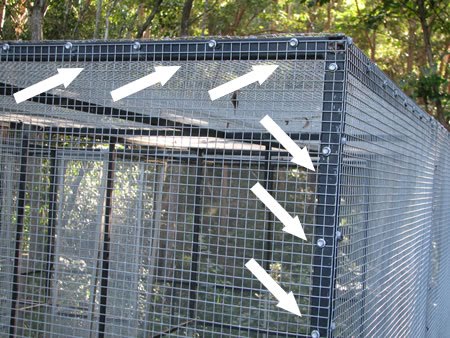
  2. When drilling in the tech screws, make sure that each screw is placed tightly into the corner of each weldmesh square so that as you work your way out from the corner of the frame, the mesh is being pulled in opposing directions along the lengths of the frame. Drilling the screws in equidistant along the frame lengths will also assist in achieving a more uniform and `tighter' fit.
The ultimate goal is to achieve as tight and flat a weldmesh panel as you can. There's nothing daggier than a `bubbled' or floppy sheet of weldmesh on your aviary so take your tiome to get it right - you'll be looking at the results for years to come ;-) Achieving a `tight' fit is much easier when using 900mm wide sections than 1200mm wide sections, but a good tight and flat fit can be gained across both dimensions if done patiently and with care (two things that are usually lacking in my aviary building by about the third sheet :-() The image below shows the directional fixing of the tech screws - although, note that I have actually fixed the top row coming from the other end, not from the corner shown. If I had started from the corner shown the top row of screws would be working away from the corner - not towards it. Basically you just need to be working against the tension and pull of the opposing frame length.


One of the most common questions I am asked about my aviaries is `What do you paint them with?' It's a good question as most parrot owners are naturally averse to anything that might traditionally be considered `toxic' to their birds. In short, I use water based outdoor paint in low sheen/flat black. I only ever use either Dulux Weathershield or Wattyl Solagard. We've used both of these for 10 years now and it's completely harmless. For tidying up the hard to reach places that aren't easily covered with the paint roller, I use a water based spraypaint - once again in flat black. Water based acrylic spray paint can sometimes be hard to locate and is more expensive but it's the only option. We never use enamel based paints.

The next question about painting that I receive is `Why do you use black?'. The answer is that bare weldmesh sheet is highly reflective of light and hence visibility through the wire is very minimal. Aesthetically, bare wire will also start to show signs of corrosion and discolouration quite quickly due to environmental exposure. To give you an example of the visibility difference between unpainted and painted weldmesh check out the picture below that I took today of two adjacent panels - one painted, the other bare.


Make sure you make an effort to come along to the Parrots 2010 Convention in Brisbane on the first weekend of July. I will be delivering a full presentation there on outdoor enrichment aviary design and construction.

Sunday, March 14, 2010

Maya's Training Diary

In the next issue of ABK Magazine I will be introducing readers to a few additions we have made over the past 18 months to our training team - a group of parrots that I use for my consultation work. One very unexpected addition was `Maya' (pronounced `my-a', not `may-a') the Green-winged Macaw. She's not going to be a permanent resident here as I don't actually `own' her but instead she is on loan for a while given her special circumstances. It was an opportunity for me to work with an almost completely parent-raised Macaw that, due to having to be support fed via crop syringe after being abandoned by her parents at fledging age, is very averse to hands and completely unlike a hand raised and imprinted Macaw. I was keen to see what sort of outcomes could be achieved with such a bird. So far it has been a challenge. Besides having almost no real trust in human hands, we are also working on minimising and hopefully eliminating some early onset feather picking behaviour on her legs that she started whilst being weaned offsite. The long-term goal is to get her partnered with at least one other Green-winged Macaw as these birds absolutely thrive in the company of their own kind and flying `solo' is not (in my opinion) the ideal lifetime scenario for a Macaw.

In the short-term however, we're going to work through the process of seeing what sort of relationship we can establish with her and take it from there. She has only been with us for three weeks and although each day is a new page in the relationship building story, I really only started some focus sessions with her 5 days ago. What I have been doing are just short, 15 minute, positive reinforcement sessions each afternoon, gradually building up her tolerance and acceptance of my proximity to her. I plan to detail these sessions in a future Pet Parrot Pointers column in ABK magazine but in the meantime, below are just a few images of the approximation pathway that we were able to achieve in Session 5 with Maya that ended with her actually placing both feet on my arm (not shown) - a huge trust moment for her! To work with birds like this is very special indeed, and humbling as a trainer as it really does challenge you to think fast, problem solve quickly, and above all, tune in to the slightest body language indicators on offer from the bird to know when to raise your criteria and shape the next stage of the behaviour. The images don't give the full reveal as they don't show just how apprehensive this bird is, but they do hopefully give some indication of just how slow good training with a parrot like this needs to be. The end result in the second last image was achieved after five 15 minute sessions over five consecutive days. No magic - no voodoo - no `bird tricks' - just patience, perseverance, keen observation, timely reinforcement delivery and above all - respect.

Image 1: Starting off where we finished the previous session with Maya taking food treats from the hand and maintaining close proximity to me without moving away to eat.


Image 2: An important approximation to consider is the nature in which the treat is taken from the hand - it provides a strong indication of the level of comfort the parrot has in the presence of the hands and trainer. A gentle taking of the treat as opposed to an aggressive `grab' informs you whether or not the parrot is starting to have confidence in its choice, trust in the trainer, and some control over its environment.


Image 3: Looks like something not worth noting but it's a critical indication of where the focus of the parrot is - firmly on the hand delivering the treat and with the confidence to look away from the trainer and towards where the reinforcement is being delivered. Time for a raising of criteria.


Image 4: Gradual desensitisation of a hand grasping her perch. Note that her proximity to me has shifted back spatially on the perch - a result of the introduction of the aversive of the arm to her environment. She is being positively reinforced for gradually moving closer to the arm.


Image 5: The level of desensitisation to the arm has enabled her to have the confidence to lean over the arm to receive a treat.


Image 6: The criteria was raised to her having to place a foot on the arm for reinforcement delivery. This was a slow process and one that had many small approximations before Maya would actually place and hold one foot on the arm. I also had some challenges getting my own body positioning right and dealing with the problem of the Macaw tail, which can be a pain in the butt when training these guys as they react aversively to their tails brushing up against things while they are apprehensive. If you're wondering why the arm is positioned on the perch and not in front of it in a more `classic' step up position, try dumping a carton of milk into your outstretched palm and see what happens. With a bird that weighs close to a kilogram and is very apprehensive towards unstable surfaces, I was relying on using her perch to support my own arm and hence her weight to give her the confidence in using my arm as an extension of her perch.


Image 7: At this stage I am shifting the target of my treat delivery hand to shape her body positioning to better facilitate her getting both feet onto my arm. This was achieved by the end of the session. So much goes into getting to a point like this in terms of considering your reinforcement delivery, setting the bird up to succeed with your own arrangement of the environment, and obviously the detail in shaping the behaviour. The next set of approximations will be working towards being able to lift Maya from the perch she is being trained on here to the one above it. That will actually be a huge leap for this ruby gem.


Image 8: Finishing on a good note with a nice cashew as a jackpot :-)

Dragon Fruit - Does it `Glow'???


I recently picked up some Dragon Fruit at the local supermarket. It's one of those exotic asian fruits that the young register person always has to ask `What is this?' at the checkout. The next question is usually `What does it taste like?' - to which I admittedly have to reply, `I've got no idea - I feed it to my birds'. I then get the look - you know - the one that kinda suggests you must be nuts if you spend that sort of money on a piece of fruit that you don't even eat and instead, feed it to your birds! It does seem crazy but doesn't it feel great to add some new taste sensations into the food bowl of your birds? I'm not sure who gets the most out of it - them or me. If you really want to know though - it tastes awful (I actually tried it this time). One of those fruits that you might suggest - `Oh, it goes great with ice-cream', in other words, it tastes like dirt on its own and needs a good smothering of neopolitan before its edible :-)

Anyway, here's a question that I'd love to know the answer for... `Does dragon fruit glow?' That's probably not the right wording for that question but it's as close as I can get to what I'm thinking. You see, when I placed a chunk of it in the food bowl of my Amazon parrots they both reeled away in obvious horror. If you look at the flesh of dragon fruit it is a brilliant iridescent white (see pic above), the same sort of white you see on iridescent fungi and other things that `glow' in the dark. Given that our parrots can see colours in the ultraviolet spectrum that we can't, it got me thinking - what does dragon fruit look like to them? It obviously had some sort of `stay away' quality to it - they reacted the same way both days in a row that I tried to feed it to them. After a while, their appetites got the better of them but watching them slowly desensitise to their food bowl and finally take the plunge to grab a piece of less offensive food and make a run for it was an interesting study in behaviour - and perhaps the strength of the predatory defence of the humble dragon fruit!

If anyone knows what the ultraviolet or `hidden' colour spectrum of dragon fruit flesh is - please e-mail me! It also served as a good reminder to be observant of our birds responses to new food items in their bowls. Sometimes a change like that can result in an aversion to accessing their food for the day. No point in persisting with expensive fruit if all it achieves is a stressed and hungry parrot! I'll keep it for the Ice-cream ;-)

Thursday, March 4, 2010

Bird Retailers & Wing Clipping

OK – here’s a contentious one, but no point in fence sitting from my perspective. I recently stopped in at a major bird retailer in Brisbane to pick up a bunch of bird supplies while I was on my way to my monthly consult sessions. Usually I don’t have much time to stop and look at the birds in retail outlets but this time I did, as it is the time of the year when there are a lot of young baby parrots available and it is always interesting to see what is entering the companion parrot community. Whilst I know that there are many highly responsible bird retailers and very good outlets for acquiring a pet parrot, what I saw in this particular store really bugged me. Every single handraised parrot waiting for sale to a pet home was clipped not one exception. None of those birds had been offered the opportunity to develop their flight skills, coordination, confidence and independence. All were recently weaned and obviously had more than likely never actually `flown’. Whilst I obviously don’t condone the clipping of a parrot’s wings, I have to accept that there is no law to prevent it or legislative authority to monitor it or set guidelines for it, therefore I have to live with it as a reality of what we see in the bird world. But geez folks – can’t we at least give the new owners of these young birds that are sold in pet stores the option??? How hard is it to keep the young birds fully feathered, provide some informed and responsible point of sale pros and cons on wing clipping, offer advice on training and accessing training resources on managing a flighted bird, encourage the buyer to visit a qualified veterinarian to have any clipping done if it has to be done, and most of all, give the parrot a chance to be a parrot.

I then had the unfortunate experience of standing beside one of the sales assistants as a father and son team came in to buy a budgerigar as a pet. Having no handraised or tame budgies to choose from, a young bird was selected from the flock and promptly clipped. Not a progressive clip method used there either – the good old full primary and secondary chop. The sales assistant justified the procedure as nothing more than a `haircut’ – obviously using the analogy to explain that the clipped wings will be replaced over time by new ones. I just can’t seem to remember not being able to walk out of the salon the last time I had a trim. Mind you – my hairdresser is licensed to sell alcohol so a visit there is perhaps not without the potential for a major modification of my physical capabilities. Hmmm.

I think it’s about time that some guidelines and best practice recommendations for the physical modification of parrots within retail outlets was implemented. Parrots presenting with behaviour management issues that also have clipped wings account for the highest proportion of birds in the demographic of my clients. It’s more of a precursor to behavioural abnormalities arising in companion parrots than having them flighted and presents a significantly more complex set of circumstances to develop successful management strategies for – particular birds that are over-dependent or have established feather picking behaviour.

What we need to be clear on is this – keeping a parrot flighted can be successfully managed. Yes, it’s more work, yes, there may be some challenges to overcome, but let’s at least give these birds a start in life where being clipped is not a fait accompli and they are given the opportunity to learn to adapt to a captive life whilst retaining their full complement of physical capabilities.

One final frustration with this particular retailers approach to the selling of handraised parrots as pets was the lack of suitability of some of the species for sale. It seemed as though their only criteria for having a bird available for sale as a pet was that it was handraised - didn't seem to matter what species it was. The most glaring example of this were Pale-headed Rosellas for sale as pets. Honestly, as much as I dearly love the Platycercus for all of their gaudy beauty, I couldn't think of a species more unsuited to life within the confines of a small indoor cage for most of the day. Not only is their lack of adaptability to close confinement a major concern, they don't tolerate tactile handling in the form of head scratches and mature birds have a strong behavioural tendency towards intense territorial aggression that I have yet to see not hold true. I'm also yet to find a pet parrot owner that doesn't consider head scratches and that sort of close tactile interaction with their birds a very desirable reason for them keeping a companion parrot. It's a little like selling a dog that doesn't tolerate being patted. Now before anyone suggests that `there's a right home for every bird' - do you honestly think the retailer is going to screen buyers that walk in wanting a pet parrot and make the mistake of picking the Rosella because blue and yellow are their favourite colours??? Therein lies the problem folks. Betcha we'll see a couple of Pale-headed Rosellas up for grabs in the Weekend Shopper some time later this year - advertisement might run something like this... (additional info in brackets not supplied in ad)

`Pale-headed Rosella. Handraised and wIll make great pet (didn't for us - but might for you!) Owner moving interstate (to get as far away from nightmare parrot as possible). Comes with cage and bag of seed (hates the cage but loves the seed). Whistles (on..and on...and on.... until you let it out of aforementioned cage that it hates) Make an offer (folks, we're desperate, if you're here by 9am we'll just give it to ya)'. Hmmm.


A young and recently weaned Blue-fronted Amazon. Fully flighted, engaging, challenging - and manageable just as he is!

Snakes & Birds… Don’t mix

As much as I love living where I am surrounded by natural, sub-tropical wet forest that includes remnant patches of Piccabeen Palm groves and a meandering creek, the downside is that it’s also prime habitat for those legless things that have a tendency towards adding birds to their daily cuisine menu. I’ve encountered five different species here since we built our house – not bad. Over the past 6 years we have averaged two to three snake removals per year from on, in or around our bird aviaries. I recently remarked to someone that this year had been a good year – no snakes! As the words left my mouth I looked around for that proverbial bit of `wood’ to touch as I knew the season had a ways to go – particularly given that February to April are the wettest months here, and that’s the perfect time for close encounters of the slithery kind. You see, Carpet Pythons in particular are a little like us – complete sooks when it comes to getting drenched. Inclement weather sets in, and they start looking around for somewhere cosy, warm, and dry! Problem is, if you’re a birdkeeper – such criteria for a welcome escape from the elements is often perfectly filled by our backyard aviaries. In the past week, with the deluges hovering around South-east Queensland, I had to perform three python removals in a single week. Whilst that in itself isn’t exactly `blog worthy’ here's what is…

The first snake was relocated on Thursday morning after being extracted from the aviary roof the previous evening (he spent the night happily chilling inside a pillow case – my wife doesn’t know yet). On Friday morning, my usual feed rounds were interrupted by yet again, another carpet python peering back at me, at eye level mind you, about 30cm away from my face and in exactly the same spot where the first one was removed from only 24 hours prior. I had read about carpet pythons moving in on the territory of others that had been relocated but within the same day?!? So, we moved him to a completely different side of Noosa and hoped that the serpentine adventures were over. Twas’ not to be! That same night we were alerted to something not quite right in the `zoo’ by the sound of a very agitated (and bald) African Grey – Cheeky. Poor old Cheek was letting out the most god-awful wail whilst trying valiantly to fight off yet another carpet python trying to get into his enclosure (and thankfully failing). Upon capture, it was obvious to me that this was the original snake that had been relocated less than 36 hours before and had managed to travel over 10 kms in that time to be found perched (or coiled as it was) in exactly the same spot that I obviously had the audacity to remove him from originally. Not bad for something that doesn’t even have legs. I had heard about snakes traveling distances of 2 to 3 kms to return to a spot they had been removed from but 10 k’s??? It’s not like it’s a direct corridor from where he was placed either – it’s heavily fragmented, mixed suburban and semi-rural habitat that includes a train line splitting the area we dropped him off in and our home area. Dang!

Anyway, lessons to be learned here – when you relocate snakes, make sure you really relocate them – ie. As damn far away as you can drive and preferably with a major water barrier between their new home and yours. Below are two pics of two different snakes we caught last season (I didn’t bother to photograph the recent pair – I was too pissed off to bother). One of the pythons below had a very interesting `coffee’ colour, unusual for coastal carpet pythons who are normally coloured like the first snake shown.


Thursday, February 11, 2010

New Education & Training Initiative at BBEVS

We are now offering special `Hands-on' sessions at the Brisbane Bird & Exotics Veterinary Service Parrot Behaviour Consult Clinics. These sessions will offer an opportunity for people interested in owning a parrot, but who have not yet made the leap, to develop an introductory understanding of the essentials of new parrot ownership. The consult will cover a discussion of enclosure, diet, and enrichment needs of companion parrots, an overview of the essential resources required by the new parrot owner, and an opportunity to develop some basic `hands-on' handling and training skills with one of our parrots. Clients will also be able to fire away with questions on selection, acquisition and suitability of parrots as pets. This will absolutely be the best point of access to information that will hopefully set the prospective parrot owner up to succeed. Most of you reading this will already be parrot owners so... I am hoping that if you are communicating with anyone interested in taking on the challenge of a parrot as a companion animal (and if they live in SE Qld obviously!), then please refer them to this service - it can really make the difference for people making an informed decision. If you are a breeder, then why not value add one of these consult sessions in as a pre-purchase service. If anyone is interested in finding out more about this service and/or would like to make a booking for one of these `pre-purchase' clinic consultations then please e-mail me directly via jim@pbec.com.au to discuss your goals so that I can tailor our session as directly as possible to your needs and situation. The sessions are available only on the third Saturday of each month at Brisbane Bird & Exotics Veterinary Service - Macgregor, Brisbane. To add to the incentive - You can also select from one of the parrots below to use as your `trainer' bird!!! (There may be times when one of these guys isn't available but just get in touch and we'll see what we can organise ☺).

Our `Trainer' birds...

`Lola' - Yellow-crowned Amazon


`PJ' - Black-headed Caique


`Wobbles' - WA Galah


`Nandy' - Nanday Conure


`Maya' - Green-winged Macaw


`Alphonso' - Yellow-naped Amazon