Sunday, May 30, 2010

Pan-Pac Veterinary Conference


Last week I gave a series of lecture presentations, followed by a practical parrot training workshop, at the Pan Pacific Veterinary Conference that was held in Brisbane. Lecturing to veterinarians from a variety of interest groups within that profession can be a challenging task - particularly when it comes to discussing approaches and methodologies of behaviour consulting with parrots. I suspect that many of the traditional paradigms of thinking for the behaviour management of pet birds persist within the veterinary field. However, the group I lectured to really did seem to be wonderfully receptive to a more progressive approach that embraced Applied Behaviour Analysis and Functional Assessment of behaviour. I noticed quite a few `light bulb' moments occur throughout the day that served as great positive reinforcement for me.

Whilst I am certain that the vet group came away from the day with a lot of great, practical, information and advice - I certainly came away with a deeper appreciation for some of the time constraints that our veterinarians face in their clinic consultation work. What blew me away was that for many of the vets I spoke to informally during the day, a standard consult time allocation was just 15 minutes. Not a lot of ground you can cover in that amount of time if we're talking about the complexities of parrot behaviour! There was a strong sense that dealing with discussions on parrot behaviour with clients was too overwhelming and time consuming. It challenged me to come up with ways to support the vets in being able to deliver small, but potent, pieces of information on behaviour to their clients. For most of them, I think the criteria for what they might consider success in working with a client on parrot behaviour issues was too high. Just as we see when we raise the criteria for our birds too high, too soon, with our own expectations of ourselves we often see a loss of behavioural momentum and a diminishing of opportunities for learning if we fail to recognise the small approximations of achievement that we make before the end `goal' is reached. It truly was a great opportunity for me, particularly coming from outside of the veterinary community, to work with such a great group of professionals. My sincere thanks to Dr. Deborah Monks for organising the opportunity and to Dr. Melinda Cowan and Dr. Kim (Sorry Kim - I didn't get your surname!), for helping with all my `gear' and birds. A very special thanks, to Phil Ghamraoui who helped as a second trainer for the practical session. Finally - thanks to my `teachers' for the day - PJ my Black-headed Caique, Lola my Yellow-crowned Amazon, and a gorgeous little Meyer's Parrot that I will talk about in a future post.

Saturday, May 22, 2010

`What is `Browse'???

I remember a few years back at the Parrots 2006 Convention when an audience member asked one of the presenters `What is browse?' when the presenter was talking about the term in the context of enrichment for parrots. Basically, the term comes from the Zoo industry and was probably first used to describe the bunches of eucalypt leaf that are provided daily for Koalas. If you watch the behaviour of Koalas when they receive their gum branches they get straight into `browsing' through the fresh `tip' to find the juiciest, newest shoots to eat. Parrots do much the same with fresh, leafy, native branches - browse through it in search of something to chew on. Hence the term `browse' in reference to the provision of leafy branches for our birds. Leafy browse on its own though can sometimes have limited value for our parrots as the leaf isn't normally edible and what we usually observe is some interest in snipping off the leaves and chewing up the bark. That in itself is great behavioural redirection away from undesirable behaviours, such as overpreening. However, to increase the motivation value of browse in the aviary or enclosure then consider integrating some highly valued food items. Check the example below with the Black Lories accessing their watermelon chunk that has been skewered onto a branch of their browse. Here are a few other tips for increasing the value and interaction time associated with browse:
  • If you have a parrot that is a reluctant bather and you are concerned about a low humidity environment then soak the leafy browse in water before placing it in the enclosure or aviary. Many parrots will rub through the wet leaf to access the moisture and in an indoor environment the additional damp on the leaves can help to increase the surrounding humidity.
  • If your parrots naturally have a terrestrial feeding tendency then consider creating a `foraging pit' and use the laves, bits of branch, seeding cones etc at ground level. Sprinkle some budgie seed amongst it all with just a few sunflower seeds for an occasional jackpot reward for the foraging behaviour and you will keep them entertained for hours.


Fresh, leafy eucalypt branches can provide a valuable distraction for parrots during the day.

Increasing the motivation to forage and explore through browse can be achieved by integrating their feeding experience into the browse itself


Terrestrial feeders, such as these Galahs, benefit more from having their browse provided in the form of a ground foraging pit

Thursday, May 6, 2010

Parrots with Gambling Problems...


Undoubtedly the greatest frustration I encounter in working as a behaviour consultant with parrot owners is that when it comes to accessing support and advice, I’m most often seen as the `last resort’ rather than the `first resort’. It’s difficult to explain to people what the potential consequences are when the response pathway for working on problem behaviours follows a whole bunch of old school thinking, homespun remedies, or intervention programs that completely fail to appreciate exactly what behaviour and learning are all about. Let’s be honest though – we live in a society that demands `quick fix’ solutions. I often use the `drive-through, take-away’ approach as the analogy of choice as it encapsulates well how we tend to go through life looking for the most convenient, least hassle, quickest, and cheapest solution to our problems. Hence why the popularity of a range of well-marketed online behaviour and training products and `solutions’ can be so appealing. It’s also why there is a proliferation of chat boards, discussion groups, and online forums for parrot owners – all providing a quick, convenient, and most importantly `free’ access point for the struggling parrot owner to find answers to questions that can be super complex at times. The dilemma for someone like me is that by the time I see the client in the consult room or in their home, I’m trying to clean up a dropped meat pie – it’s just a darn mess! I have a tendency to use a little saying that I learnt from Avian Trainer, Steve Martin - `Set Up for Success’ - in my approach to working with birds and their owners. Problem is, I’m usually the one who is the least set up to succeed. What got me really thinking about this was an article in the latest issue of the IAATE magazine `The Flyer’. The article is titled `Behaviour Fundamentals: Filling the Behaviour Change Toolkit’. It’s an absolute gem, written by one of my great mentors – Susan Friedman PhD. Here’s the final paragraph to ruminate on…

`One mystery that often surrounds problem behaviour is its very persistence. People may have a litany of failed behaviour-change programs by the time they turn to behaviour analysis for help. As they wade through the personal recipes of one Internet charlatan after another, people don’t realise that, with each failed attempt at behaviour change, the window of opportunity closes a little bit more because the problem behaviour is intermittently reinforced. Intermittent schedules of reinforcement build persistent gamblers, willing to behave again and again, without reinforcement, for that one jackpot that inevitably occurs. There should be nothing casual about intervening on an animal’s functional `misbehaviour’. Each intervention should start with a careful functional assessment, and the intervention should be designed to meet the needs of the animal, using the most positive, least intrusive methods. The greater our knowledge of the scientific principles and procedures of learning and behaviour, the more effectively we will meet the needs of the animals in our care.’

Don’t feed your parrot’s gambling habit. When problems start to surface, get support, advice, and a behaviour change plan worked out that uses an approach based on the science of learning, and the art of building a lasting relationship with your bird. Quick fix solutions are for gamblers – effective behaviour change takes work, commitment, and consistency of reinforcement schedules. Most importantly of all - it requires partnerships, between you and your bird, and sometimes, a consultant willing to walk the journey with you - not just serve you at the drive through.

Monday, April 26, 2010

Maya's Training Diary - Step Up Critique

I was fortunate enough to have my good friend and brilliant photographer Peter Odekerken stop by yesterday to take a few images. If you're unfamiliar with Peter's work then check out his website at http://www.parrotimages.com.au He will be lecturing on parrot photography at the Parrots 2010 Convention in Brisbane on the first weekend in July - be there good feathered people!

What was great about having Peter take some snapshots is that his camera is able to take up to 9 frames per second, allowing me to analyse the minutiae of what's going on when I'm working with a bird. As I discussed in my previous training diary entry about `Maya' our Green-winged Macaw, this is a bird that is highly averse to hands and is significantly lacking in trust towards humans. She was almost completely parent raised and had to endure an 8 week period of being force fed via gavage tube whilst being weaned due to her parent's deserting her nest. As you can imagine, daily restraints and force feeding episodes completely eroded this birds acceptance of hands. We've been rebuilding the trust account with her, slowly, and at her pace. It's been a remarkable learning experience and a very good opportunity for me to get back to being challenged in regards to the clarity of my antecedent arrangement, communication, reinforcement delivery, and most importantly - `patience' when training.

Here's a couple of cool things I picked up when looking back at the images Peter took...

Firstly - what's wrong with the picture below? Note the posture of Maya upon the presentation of the hand cue as I am getting ready to request a step up. A keen trainer will notice that she's leaning slightly away from the hand, is extremely upright, and her foot is held up more defensively rather than a desirably relaxed position. Her body weight is shifted away from the hand rather than towards it, thus taking any possible momentum towards a step up out of the equation. Acknowledging these subtleties in body language is what sensitive training is all about. What many owners are inclined to do is to continue with the cue, possibly coerce the bird into stepping up, and as a result, achieve the goal without their being a true `choice' and decision making process afforded to the bird. I backed out, allowed her to re-perch, relax, re-evaluate, and hopefully present some more confident body positioning upon the presentation of a new cue.


Now have a look at the next image below. What's wrong here? The body positioning is better and the weight shift is more indicative of confident movement towards the hand but... that hand position is all wrong. The last thing I want Maya to do is to place her right foot at the end of my hand and leave no room for her left foot to follow. This is a bird that has zero tolerance for an unstable perching surface - particularly when that is a human hand. Time to remove the cue before the foot touches the hand, reinforce the confident movement towards the hand and rebuild the momentum by repositioning my hand to better set her up to succeed in achieving the goal of both feet on my arm.


The image following shows where I needed her right foot to be placed - on my wrist and thus allowing plenty of room for her left foot to follow and fall into position for a comfortable step up.


As you can see, she's building her confidence week by week. Parent raised Macaw folks. Very humbling.


Enrichment Aviary Project - Update

It's been a while since I posted about the new aviary complex that I'm working on to house some of our parrots. I've been hard at it again this past weekend and with the wiring of the frames now completed and painting started I thought I would share a few insights into these two aspects of the construction.

First up, let's talk about attaching weldmesh to the aviary frame. For a novice or someone inexperienced this can end in a really poor looking aviary and an awful lot of frustration. A couple of pointers that might help when you are applying the weldmesh sheets are:
  1. When placing the weldmesh sheet against the frame, make sure that the `bow' (created by the wire having come from a roll) is directed away from the aviary. Think of it as placing the weldmesh sheet so that it forms a convex arc away from the frame - rather than a concave curve towards the frame.
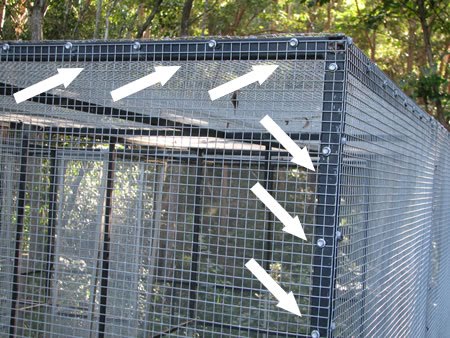
  2. When drilling in the tech screws, make sure that each screw is placed tightly into the corner of each weldmesh square so that as you work your way out from the corner of the frame, the mesh is being pulled in opposing directions along the lengths of the frame. Drilling the screws in equidistant along the frame lengths will also assist in achieving a more uniform and `tighter' fit.
The ultimate goal is to achieve as tight and flat a weldmesh panel as you can. There's nothing daggier than a `bubbled' or floppy sheet of weldmesh on your aviary so take your tiome to get it right - you'll be looking at the results for years to come ;-) Achieving a `tight' fit is much easier when using 900mm wide sections than 1200mm wide sections, but a good tight and flat fit can be gained across both dimensions if done patiently and with care (two things that are usually lacking in my aviary building by about the third sheet :-() The image below shows the directional fixing of the tech screws - although, note that I have actually fixed the top row coming from the other end, not from the corner shown. If I had started from the corner shown the top row of screws would be working away from the corner - not towards it. Basically you just need to be working against the tension and pull of the opposing frame length.


One of the most common questions I am asked about my aviaries is `What do you paint them with?' It's a good question as most parrot owners are naturally averse to anything that might traditionally be considered `toxic' to their birds. In short, I use water based outdoor paint in low sheen/flat black. I only ever use either Dulux Weathershield or Wattyl Solagard. We've used both of these for 10 years now and it's completely harmless. For tidying up the hard to reach places that aren't easily covered with the paint roller, I use a water based spraypaint - once again in flat black. Water based acrylic spray paint can sometimes be hard to locate and is more expensive but it's the only option. We never use enamel based paints.

The next question about painting that I receive is `Why do you use black?'. The answer is that bare weldmesh sheet is highly reflective of light and hence visibility through the wire is very minimal. Aesthetically, bare wire will also start to show signs of corrosion and discolouration quite quickly due to environmental exposure. To give you an example of the visibility difference between unpainted and painted weldmesh check out the picture below that I took today of two adjacent panels - one painted, the other bare.


Make sure you make an effort to come along to the Parrots 2010 Convention in Brisbane on the first weekend of July. I will be delivering a full presentation there on outdoor enrichment aviary design and construction.

Thursday, April 22, 2010

Sulphur-crested Sex Change...

Hmmm. Bet the title of this post got you interested eh? I was at the BBEVS Surgery last Saturday to do my monthly consult clinics and I overheard one of the most amusing discussions I have yet to encounter about parrots. The two people engaged in the following banter weren't clients of mine - they were in to see the vets and `met' at the reception upon bill payment time. One was a dog owner and the other was the owner of a Sulphur-crested Cockatoo. The Sulphur was perched very proudly on the shoulders of the owner. It was attracting quite a deal of attention as it was sporting a rather regal looking elizabethan collar, no doubt to keep it from picking at whatever body part had just been treated as it otherwise looked pretty good! Here's a brief snapshot of the conversation...

Dog owner: `Oh - what a lovely Cockatoo!'
Cocky Owner: `Thankyou. Yes. He's a beautiful bird'
Dog Owner: `My old Aunt used to have a Cocky as a pet. Had it for years. I used to look after it every now and then'
Cocky Owner: `Really?'
Dog Owner: `Yeah. Didn't like men but - hated 'em. They can be like that you know'
Cocky Owner: `I've heard'
Dog Owner: `Yeah - and you know what else?'
Cocky Owner: `What?'
Dog Owner: `They can change their sex - like go from being a boy to a girl or whatever'
Cocky Owner: `Really?'
Dog Owner: `Yep. They need to do it in the wild. When we had to look after my Aunt's cocky I read up on 'em. Found out that if there's a shortage of one sex or the other in the wild they can just change so they can breed'
Cocky Owner: `Oh?'
Dog Owner: `Uh huh. You'd be amazed 'eh. Amazing birds. Always wanted one myself - too noisy but 'eh?'
Cocky Owner: `Mmmm - can be'

You probably think the above is a joke but I'm serious - that's almost verbatim what was said. As funny as it obviously is to think that anyone could believe or even think that a Cockatoo can just `change its sex' in the wild, it got me thinking about the level of misinformation that is out there about parrots and how so many of these old ways of thinking persist within the birdkeeping community. Most of it, to be honest, is pretty harmless. Sometimes however, clearly outdated yet very much perpetuated thinking about parrots can potentially be very damaging. I'll save a good example of that for a future blog post but for now, if you think you're probably holding on to a few old school lines of thinking about your birds well, as my teenage students like to tell me, `time to get updated' :-)


Wild Sulphur-crested Cockatoo foraging. Male or Female? Depends... apparently.

Wednesday, April 21, 2010

Melbourne Companion Parrot Workshop


It's been a couple of weeks since we conducted our first Companion Parrot Workshop in Melbourne, Victoria and I still have a `buzz' from the very cool experience working with some fantastic parrot owners on that day. The participants gained a massive amount of information over the 8 hours (we just kept going after the `official' full-time!) and it was so pleasing to see the networking and story sharing going on throughout the day. One of the most rewarding aspects of conducting these days is seeing parrot owners make new and like-minded friends and build their support network - which can be so essential when we encounter challenges and difficulties with our birds.

A remarkable aspect of the demographic in attendance at the workshop was that around 75% of them were Eclectus Parrot owners! What is it about the Eclectus Parrot that often generates a set of real, and sometimes unique, challenges for their owners? In my experience, as both someone who has worked with them in my own collection over the years and also as a consultant called on to support owners managing their behaviour, enrichment, and training over the past 10 years, the Eclectus is very much a bird that we seriously need to spend more time learning about their long-term care needs in captive environments. For me, they are the classic example of how we often get it wrong when we apply the one approach fits all methodology to parrot keeping.

One element that really seems to be feeding (pardon the pun) into the behavioural equation with our Eclectus parrots is the manner in which their owners are managing their diet and daily food intake. Perhaps more so that any other groups of parrot owners I encounter, keepers of pet Eclectus parrots seem to really go overboard with just about every aspect of the feeding program for their bird. A lot of the Eclectus I am seeing (particularly those developing problematic behaviours) are fed excessive amounts of nutrient dense, often high carb, foods at excessive quantities 7 days a week, 365 days a year. The `All You Can Eat Smorgasbord' seems to be the common Eclectus owner's approach to diet management. If you ever get the chance, dial your ear in to a conversation between Eclectus owners. The rap almost always immediately directs itself towards `What do you feed your guy?' Eclectus owners are obsessed with the diet of their birds! Pasta diets, rice diets, large quantities of sprouted seed, as much corn and high sugar fruits as you can eat, human table foods (`awww - but he loves it when we have Pizza') and let's wash it down a few nuts - but hey, just as treats right? ;-) I gotta say - if there's such a thing as reincarnation - I wanna come back as a pampered Eclectus! Now, getting enthused about the diet of our parrots is a good thing - I'm just as passionate about the whole issue of feeding my birds as the next owner. Where we seem to be going wrong is losing sight of the reality of what these birds in their wild state have biologically evolved to feed on, the manner in which they access that food, the volume they would normally be able to obtain vs the energy expenditure required to source and access their daily food intake, and the seasonally fluctuating nature of the nutrient composition of their diets.

Compounding the complexity of getting an Eclectus diet `right' is the increasing anecdotal evidence of problems such as toe tapping and wing flipping being associated with processed foods and some pelleted diets. Those issues aren't the only problems - an increasing number of companion Eclectus parrots are presenting with severe feather picking, chronic masturbating, and concerning escalations in the frequency and intensity of territorially aggressive behaviour. Of course, as a behaviour analyst, evaluating the immediacy of what is occurring in the environment of these birds is the first stage in a pathway towards understanding the problem behaviour and developing behaviour change solutions. However, my approach towards developing some `bigger picture' solutions when working with clients of Eclectus parrots always includes a careful evaluation of the diet management of their bird. For my thinking, when we pump these birds full of nutrient dense foods in excessive quantities 365 days a year it must surely be providing an influence on the physiological state of the bird that has flow on effects in terms of the observable behaviours and responses to environmental stimuli that we then start to see.

It's not just diet issues either - we can now start to see (after nearly 10 years of Eclectus being available to the pet market in Australia and a good sample size to draw anecdotes from) that the social nature of the species, in particular the males, may also be influencing some of the failures to maintain these birds as behaviourally active, engaged, compatible with humans, and healthy, in captive conditions. And the females???... I'll leave that for a future Blog ☺

To all the participants at the Melbourne Workshop (too many to name - you know who you are you bird nerds!), thankyou so much for helping to make that day such a positively reinforcing experience for me - I hope you enjoyed the learning and sharing as much as I did!!!


Two young male Eclectus parrots - growing up and developing life skills in an aviary environment that facilitates the level of activity, exploration, and exposure to environmental stimuli that these birds thrive in.